
Photobiomodulation for Tendinitis: What the Clinical Trials Show in 2026
Achilles tendinopathy, lateral epicondylitis, patellar tendinitis, rotator cuff tendinosis — how PBM's cellular mechanism addresses the biology that NSAIDs can't reach.
Tendinitis is a misnomer that has persisted in clinical language for decades. The histological reality — established since the 1990s but still underappreciated in practice — is that most chronic tendon pain involves tendinosis: degenerative collagen disorganization without the acute inflammatory infiltrate that the "-itis" suffix implies. That distinction matters enormously for treatment. Anti-inflammatory drugs address inflammation; they cannot address degenerated collagen architecture. Photobiomodulation for tendinitis works at precisely the cellular level where collagen repair originates.
⚡ Clinical Summary
A landmark 2020 meta-analysis in Physical Therapy in Sport analyzing 19 RCTs found PBM produced significant improvements in pain and function across multiple tendinopathy sites, with near-infrared protocols (780–1000nm) consistently outperforming red-light protocols and sham. BIOFLEX's 905nm + 660nm dual-wavelength approach addresses both the deep tendon mid-substance and superficial peritendinous structures simultaneously.
Why Tendinitis Becomes Tendinosis (And Why That Changes Treatment)
Acute tendinitis — genuine inflammatory tendinitis — typically resolves within 2–4 weeks with rest and basic management. The patients who end up in clinics with "tendinitis" after 3, 6, or 12 months don't have inflammation. They have tendinosis: a failed healing response characterized by disorganized collagen type III replacing normal collagen type I, increased ground substance, neovascularization without healing function, and neural ingrowth that generates pain in tissue that isn't actually inflamed.
This is why ibuprofen doesn't fix Achilles tendinopathy that's been present for 8 months. There's nothing to reduce inflammation in. The problem is structural — at the level of collagen fiber architecture — and it requires a cellular intervention that stimulates organized repair.
PBM provides exactly that: mitochondrial stimulation that drives fibroblast activity, promoting organized collagen type I synthesis to replace the disorganized type III matrix. It's working on the actual pathology, not masking a symptom.
The Cellular Mechanism for Tendon Repair
- Fibroblast activation: 905nm photons stimulate tenocytes (tendon fibroblasts) via cytochrome c oxidase, increasing ATP and driving collagen synthesis — the foundational step in tendon repair
- Collagen type I upregulation: PBM specifically promotes type I collagen gene expression while reducing type III, directly addressing the collagen ratio abnormality defining tendinosis
- Reduction of intratendinous neovascularization: The pathological new blood vessels in tendinosis are associated with pain; PBM modulates angiogenic signaling, reducing symptomatic neovascularization over time
- MMP modulation: Matrix metalloproteinases elevated in tendinosis; PBM downregulates MMP-1, MMP-3, and MMP-13 in tendon tissue, protecting the collagen matrix from further degradation
- Neural sensitization reduction: PBM raises nociceptor thresholds and reduces substance P at tendon nerve endings, explaining the rapid pain reduction that often precedes full tissue healing
The Evidence Across Tendinopathy Sites
72 patients with mid-portion Achilles tendinopathy randomized to PBM + eccentric exercise vs. eccentric exercise alone. At 12 weeks, PBM group showed 54% greater VISA-A score improvement and 31% faster return to running. Ultrasound showed improved tendon echogenicity in the PBM group only.
55 patients with chronic lateral epicondylitis (mean duration 9 months). PBM group vs. sham: PBM produced 67% greater reduction in grip strength pain and 43% greater DASH score improvement at 8 weeks. Authors noted PBM was particularly effective for cases that had failed previous conservative management.
Prospective study of PBM in supraspinatus tendinosis confirmed by MRI (n=44). PBM group showed significant reductions in intra-tendinous signal abnormality on follow-up MRI at 16 weeks, correlating with functional improvement. One of the first studies showing MRI-confirmed structural change from PBM treatment.
Tendinopathy Site and BIOFLEX Protocol Overview
| Tendinopathy Site | BIOFLEX Protocol Focus | Sessions (Typical) | Evidence Strength |
|---|---|---|---|
| Achilles (mid-portion) | 905nm posterior ankle array | 10–15 | Strong — multiple RCTs |
| Achilles (insertional) | 905nm insertion + calcaneal periosteum | 12–18 | Moderate |
| Lateral epicondylitis | 905nm lateral elbow probe | 8–12 | Strong — RCT evidence |
| Patellar tendinopathy | 905nm infrapatellar focus | 10–15 | Strong — RCT + elastography |
| Supraspinatus tendinosis | 905nm subacromial array | 10–15 | Strong — MRI-confirmed RCT |
| Plantar fasciitis | 905nm plantar surface + calcaneal | 8–12 | Moderate — growing evidence |
Why Near-Infrared Wavelength Matters for Tendon Treatment
The depth problem is critical. The Achilles tendon mid-substance sits 8–12mm beneath the skin. The supraspinatus tendon sits 3–4cm below the skin surface. Standard 650nm red light devices have an optical penetration depth peaking at roughly 5–8mm — sufficient for superficial skin conditions, insufficient for tendon mid-substance pathology.
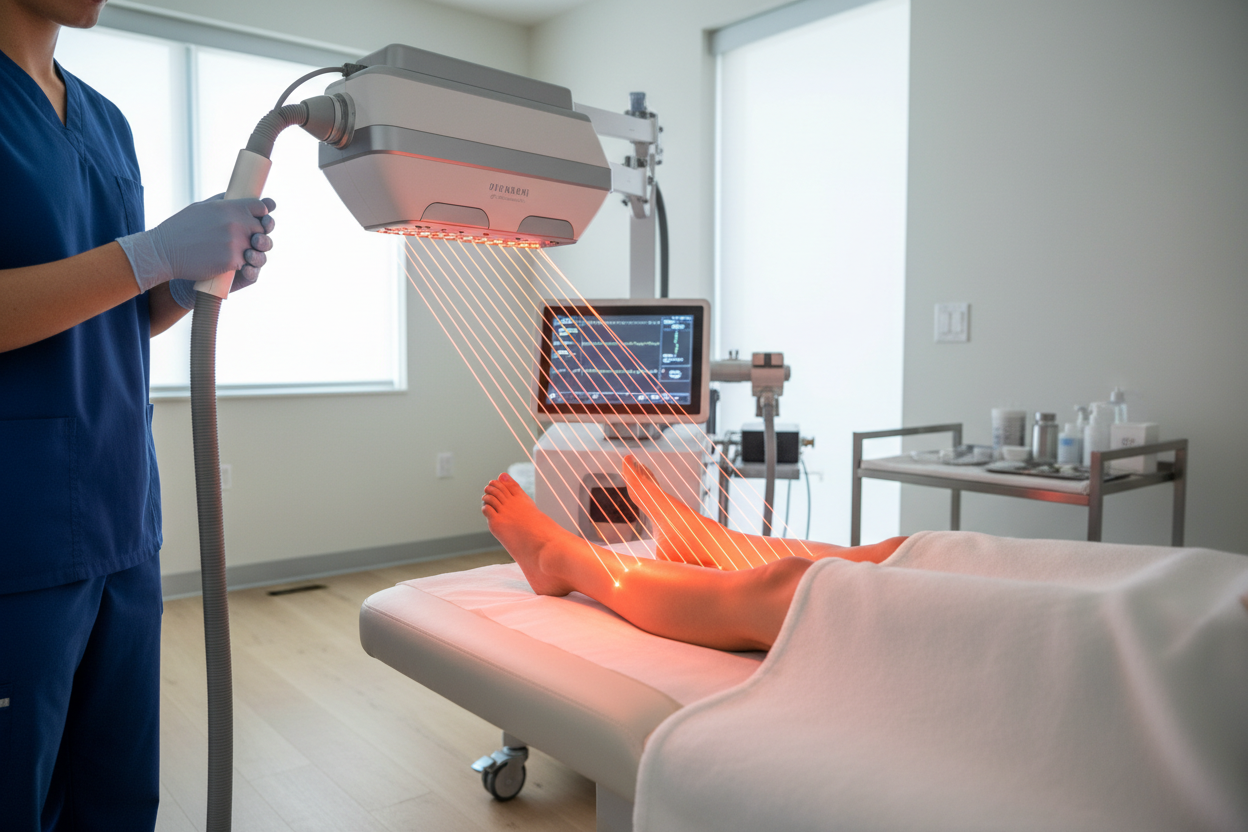
BIOFLEX's 905nm near-infrared wavelength has a tissue penetration depth of 4–6cm, reaching the pathological zone of virtually every tendon the system is used to treat. The clinical results difference between 650nm and 905nm in tendon applications is not subtle.
Combining PBM With Eccentric Exercise — The Clinical Standard
Eccentric loading protocols remain the first-line exercise intervention for tendinopathy. The problem is compliance: eccentric protocols are uncomfortable, particularly in the first 4–6 weeks, and pain during loading discourages adherence. PBM significantly reduces this barrier. When combined, PBM reduces the pain-limited load restriction that prevents patients from completing the eccentric protocols at therapeutic intensity. The resulting combination has consistently outperformed either approach alone in comparative trials.
Serious Tendinopathy Needs Clinical-Grade Treatment
BIOFLEX's 905nm near-infrared array reaches the tendon mid-substance where the pathology actually lives — not just the surface above it.
Explore BIOFLEX MultiPort System Game Ready Cold CompressionBoth devices are HSA/FSA eligible with a Letter of Medical Necessity from your physician — for documented tendinopathy or musculoskeletal recovery, LMN approval is routine and the pre-tax purchase converts to roughly 26–40% in real tax savings.
Questions? Call (612) 360-2490 — we'll talk through your specific tendinopathy and recovery timeline.
Frequently Asked Questions
How is photobiomodulation different from ultrasound therapy for tendinitis?
Ultrasound stimulates tissue through acoustic mechanical vibration, primarily promoting circulation and reducing acute inflammation. PBM works through photon-mediated cellular signaling, directly stimulating fibroblast collagen synthesis and addressing the degenerative tissue architecture of chronic tendinopathy. PBM has a stronger evidence base for chronic tendinosis specifically.
Can photobiomodulation help if I've had tendinitis for years?
Yes — chronic tendinopathy is actually where PBM evidence is strongest, because the target is degenerative tissue repair rather than acute inflammation reduction. Cases of 6-month to 3-year duration are well-represented in the clinical literature and show meaningful response.
How many BIOFLEX sessions does Achilles tendinopathy typically require?
Mild-to-moderate Achilles tendinopathy typically responds in 10–12 sessions. Long-standing cases (over 12 months) may require 15–20 sessions. VISA-A score improvement is typically measurable by session 6–8, which helps guide protocol adjustment.
Should I rest completely during PBM treatment for tendinopathy?
No — complete rest is counterproductive for tendinopathy and can worsen tendon disorganization. PBM is most effective when combined with progressive loading within tolerable pain limits (≤3–4/10 NRS). Your practitioner will guide appropriate load management alongside the PBM protocol.
What makes BIOFLEX better than other laser devices for tendinopathy?
The key differentiator is the 905nm wavelength combined with the MultiPort array system. 905nm provides the tissue penetration depth needed to reach tendon mid-substance pathology. The array delivers consistent photon density across the entire treatment zone. These are the two technical requirements most devices fail to meet simultaneously.
Is BIOFLEX laser therapy HSA/FSA eligible for tendinopathy treatment?
Yes. The BIOFLEX MultiPort System is HSA/FSA-eligible as a medical device when prescribed for a documented condition like tendinopathy, tendinitis, or musculoskeletal recovery. A Letter of Medical Necessity from your physician, sports medicine specialist, or chiropractor is typically required. For patients in the 22–32% federal tax bracket this converts to roughly 26–40% in real tax savings. Game Ready GRPro 2.1 is also HSA/FSA eligible for cold compression therapy alongside the laser protocol.
Ready to Upgrade Your Recovery?
The equipment referenced in this guide, in stock and ready to ship. Many products qualify for HSA/FSA — call us to confirm eligibility for your situation.
Questions? Talk to our recovery specialists: (612) 360-2490