
BIOFLEX vs K-Laser: Which Professional Laser Therapy System Is Right for Your Clinic?
BIOFLEX vs K-Laser: Which Professional Laser Therapy System Is Right for Your Clinic?
A complete head-to-head breakdown of two leading cold laser and Class IV systems — covering wavelengths, clinical evidence, safety, cost, and which conditions each handles best.
BIOFLEX wins for chronic conditions, neuropathy, deep tissue pathology, and any clinic that prioritizes safety and evidence depth. Its superpulsed Class IIIb technology delivers superior tissue penetration without thermal risk, and its clinical research base is among the strongest in the field.
K-Laser wins for fast treatment times and high-power acute injury work where speed matters more than precision dosing. It is a legitimate Class IV system with good clinical adoption, but the thermal risk and higher power requirements are real trade-offs.
For most chiropractic, physical therapy, and integrative medicine clinics: BIOFLEX. For high-volume sports medicine or veterinary practices where throughput is the priority: K-Laser is worth evaluating.
I carry the BIOFLEX MultiPort System at Your Health Sanctuary and have a direct relationship with the BIOFLEX team. I did not choose this brand because it was convenient — I chose it after evaluating the clinical evidence and speaking with practitioners who use both systems in real clinic environments. What follows is the most complete BIOFLEX vs K-Laser comparison available, written for clinicians and serious buyers who need accurate information, not marketing copy.
BIOFLEX vs K-Laser: Full Comparison Table
| Category | BIOFLEX | K-Laser |
|---|---|---|
| Laser class | Class IIIb (superpulsed) | Class IV (continuous wave) |
| Primary wavelengths | 660nm (red) + 830nm, 840nm, 875nm (NIR) | 660nm, 800nm, 970nm, 905nm |
| Power output | Up to 200mW per diode (superpulsed peak higher) | 1W–15W continuous |
| Thermal risk | Minimal — superpulsed delivery prevents heat buildup | Moderate — continuous wave requires monitoring |
| Tissue penetration | Superior — superpulsed peak power drives deeper photon delivery | Good — higher average power compensates for CW limitations |
| Treatment time | 10–30 minutes per area (protocol-driven) | 5–15 minutes (faster per session) |
| Safety profile | Excellent — no thermal injury risk, safe over implants | Requires protective eyewear, thermal monitoring |
| Clinical evidence depth | Extensive — 40+ years of clinical research, 3,000+ published studies in PBM field | Strong — good evidence base, particularly for acute musculoskeletal |
| FDA status | 510(k) cleared | 510(k) cleared |
| Best conditions | Neuropathy, chronic pain, arthritis, wound healing, post-surgical | Acute musculoskeletal, sports injuries, high-volume throughput |
| MultiPort / pads | Yes — treat multiple areas simultaneously | Single handpiece |
| Entry price | ~$8,500 (clinic systems) | ~$12,000–18,000 (clinic systems) |
| Support / training | Dedicated clinical support, protocol library | Good distributor network |
| Home-use version | Yes — patient home units available | Limited home options |
| Best for | Chiropractic, PT, integrative medicine, neuropathy clinics | Sports medicine, high-volume acute injury, veterinary |
Understanding the Core Technology Difference
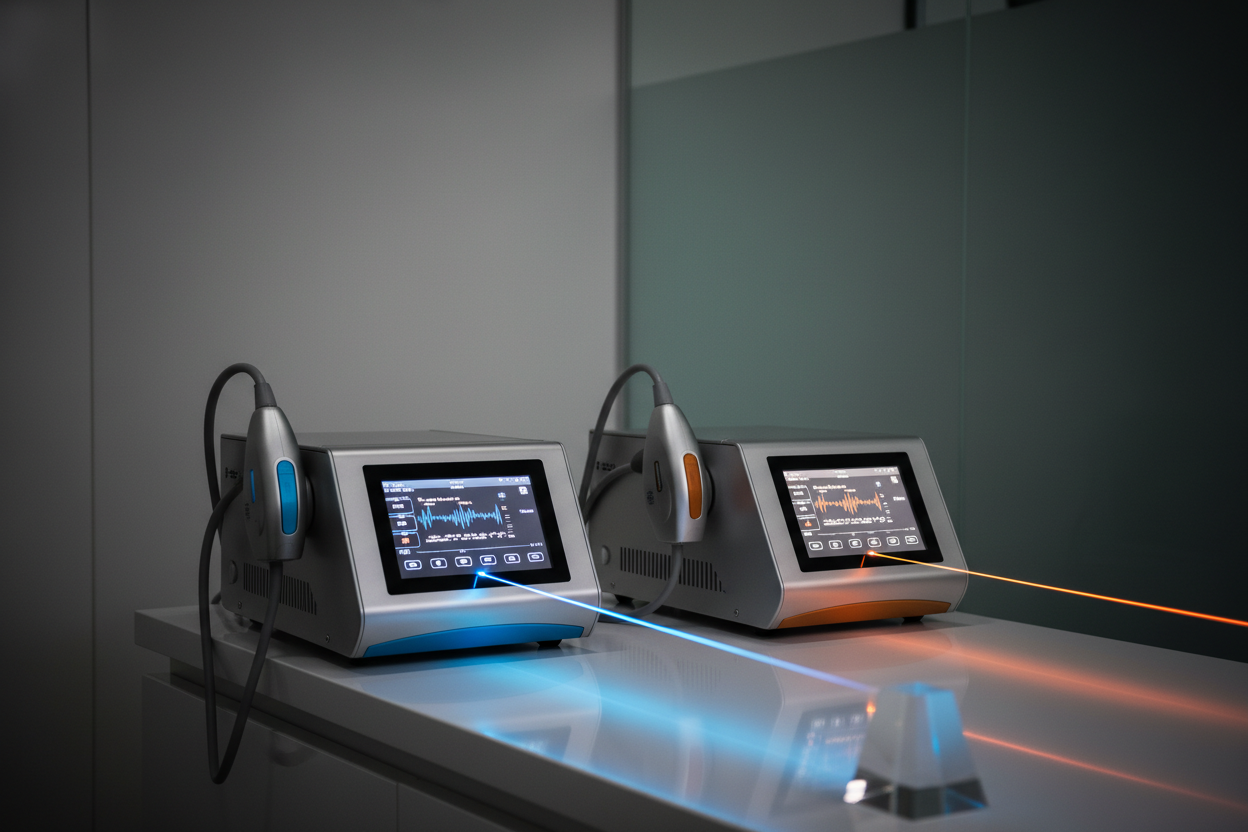
The most important thing to understand about BIOFLEX vs K-Laser is that they are fundamentally different types of devices, not just different brands making the same thing.
BIOFLEX: Superpulsed Class IIIb Technology
BIOFLEX uses superpulsed diode technology operating at Class IIIb power levels. Superpulsing means the laser delivers very high peak power in extremely short pulses — microseconds in duration — with off-time between pulses that allows tissue to cool. The result is a device that achieves exceptional tissue penetration through peak power intensity while generating essentially no thermal effect at the treatment site.
This is not a minor technical distinction. For chronic conditions, neuropathy, and deep tissue pathology, the superpulsed approach delivers photons deeper into tissue than equivalent average-power continuous wave systems, without the thermal accumulation that limits where and how long you can treat. BIOFLEX pads can be applied directly to tissue, can treat for extended protocol durations, and are safe to use near metal implants — because there is no heat to transmit.
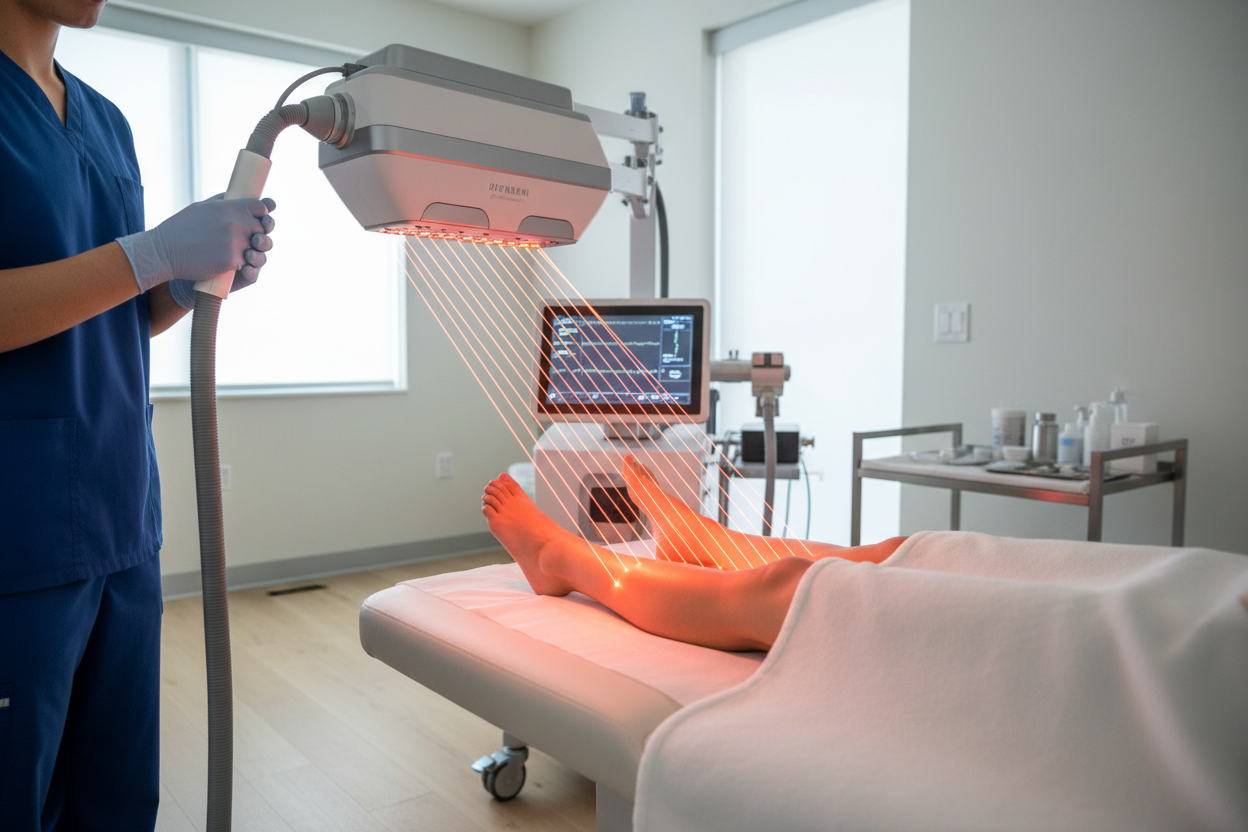
The BIOFLEX MultiPort system extends this further by allowing simultaneous treatment of multiple body areas using multiple pads driven from one control unit. A clinic can treat a patient’s lumbar spine, knee, and foot simultaneously — reducing total treatment time while maintaining protocol precision at each site.
K-Laser: Class IV Continuous Wave Technology
K-Laser operates at Class IV power levels using continuous wave emission. Class IV means power output above 500mW — K-Laser systems typically operate between 1W and 15W. The higher average power allows faster energy delivery, which is why Class IV proponents emphasize shorter treatment times.
The trade-off is thermal accumulation. Continuous wave emission at high power generates heat in tissue, which requires practitioners to keep the handpiece moving, monitor patient sensation, and avoid treating over implants or areas where thermal sensitivity is compromised. For patients with neuropathy — where heat sensation is already impaired — Class IV thermal risk is a real clinical concern.
K-Laser uses four wavelengths (660nm, 800nm, 905nm, 970nm) and has strong clinical documentation for acute musculoskeletal injuries, particularly in sports medicine contexts. For the right application, it is a capable system.
The Class IIIb vs Class IV Debate: What Clinicians Need to Know
The laser therapy field has a genuine scientific debate about whether Class IV systems offer clinical advantages over Class IIIb superpulsed systems, or whether they simply deliver more heat for equivalent or lesser photobiological effect.
The core argument for Class IV is dose delivery speed: higher average power means you can reach therapeutic dose faster. A 15W Class IV system can deliver the same number of joules in a fraction of the time compared to a 200mW Class IIIb system.
The counter-argument, supported by a growing body of research, is that photobiomodulation follows a biphasic dose-response curve (the Arndt-Schulz law as applied to PBM): too little light has no effect, the right amount produces optimal biological response, and too much light — or too much heat alongside the light — can inhibit or reverse the therapeutic effect. Superpulsed systems are designed to operate in the therapeutic window with precision; Class IV systems at high settings may exceed it in sensitive tissue.
For chronic conditions and neuropathy, where treatment durations are longer and patient tissue sensitivity may be altered, BIOFLEX’s superpulsed Class IIIb approach has the stronger evidence basis and the better safety profile. For acute sports injuries in healthy tissue where speed is the clinical priority, Class IV has legitimate advantages.
Clinical Evidence: Where Each System Shines
BIOFLEX Clinical Evidence
BIOFLEX technology sits within the broader photobiomodulation research base, which now exceeds 3,000 published randomized controlled trials and systematic reviews. BIOFLEX-specific protocols have been validated in clinical settings across four decades, with particularly strong evidence in:
Peripheral neuropathy. Multiple controlled studies document significant reduction in neuropathic pain, improved nerve conduction velocity, and recovery of sensation following structured BIOFLEX treatment protocols. This is one of the strongest evidence areas in PBM and directly relevant to the diabetic neuropathy and chemotherapy-induced neuropathy populations that many chiropractic and integrative medicine clinics serve. A 2025 systematic review of randomized clinical trials in Lasers in Medical Science found photobiomodulation therapy improved motor and sensory outcomes in patients with peripheral nerve injuries, supporting the broader evidence base behind superpulsed protocols like BIOFLEX (DOI: 10.1007/s10103-025-04541-5).
Osteoarthritis and joint degeneration. Systematic reviews of PBM for knee, hip, and hand osteoarthritis consistently show clinically meaningful pain reduction and functional improvement. BIOFLEX protocols are specifically designed for joint treatment, with pad configurations that deliver therapeutic doses to the entire joint capsule rather than just the surface.
Wound healing and post-surgical recovery. Photobiomodulation for wound healing is the best-established mechanism in the field — accelerating closure, reducing inflammation, and supporting tissue remodeling. BIOFLEX’s ability to treat directly over a wound site without thermal risk makes it particularly well-suited for this application.
Spinal conditions. Cervical and lumbar disc pathology, facet syndrome, and spinal stenosis-related pain are common presenting conditions in chiropractic practice. BIOFLEX protocols for spinal treatment have been developed and refined over decades of clinical use.
K-Laser Clinical Evidence
K-Laser has strong clinical evidence for acute musculoskeletal applications, with good documentation in:
Acute soft tissue injuries. Sprains, strains, and acute tendinopathy respond well to high-power laser with fast energy delivery. K-Laser’s Class IV output delivers rapid dose in these applications, and clinical outcomes for acute injury are well documented.
Sports medicine. High-level sports medicine programs have adopted K-Laser for return-to-play protocols, with evidence supporting faster recovery from acute athletic injuries compared to control or standard care.
Chronic musculoskeletal pain. K-Laser has good evidence for chronic back and neck pain, though the evidence for neuropathic and deep tissue conditions is less robust than for acute musculoskeletal applications.
Safety: A Critical Differentiator for Specific Patient Populations
Safety is not a minor consideration in choosing between these systems — it is a clinically significant differentiator for specific patient populations.
Patients with metal implants. BIOFLEX superpulsed technology generates no clinically significant heat and can generally be used safely over metal implants with appropriate protocol adjustments. Class IV continuous wave systems generate thermal effects and require extra caution near implants — the heat can transfer to metal hardware and cause discomfort or tissue damage in surrounding tissue.
Patients with compromised sensation. Neuropathy patients — the population most likely to benefit from laser therapy — often have impaired heat sensation. The thermal risk of Class IV systems is directly elevated in this population because patients cannot reliably report overheating. BIOFLEX’s non-thermal mechanism eliminates this risk category entirely.
Pediatric and elderly patients. Thinner skin, reduced circulation, and reduced thermal tolerance in these populations make the non-thermal profile of Class IIIb superpulsed systems a meaningful safety advantage.
Post-surgical sites. Active surgical wounds and fresh post-operative tissue are poor candidates for thermal laser application. BIOFLEX’s non-thermal delivery is specifically appropriate for post-surgical photobiomodulation as part of a recovery protocol.
MultiPort System: BIOFLEX’s Clinical Efficiency Advantage
One of BIOFLEX’s most underappreciated advantages in a clinic setting is the MultiPort system — the ability to treat multiple body areas simultaneously with multiple pads driven from one control unit.
In a busy chiropractic or physical therapy practice, treatment time is a real operational constraint. A patient presenting with lumbar radiculopathy affecting both the spine and foot — a common neuropathy presentation — can be treated at both sites simultaneously rather than sequentially. The practitioner sets up the pads, starts the protocol, and the patient receives a complete multi-site treatment while the clinician moves to another room.
This is not possible with a single K-Laser handpiece. The handpiece requires continuous clinician contact with the treatment area, making multi-site treatment a matter of sequential time rather than parallel efficiency.
For clinics treating neuropathy, chronic conditions affecting multiple joints, or post-surgical patients with multi-site recovery needs, the MultiPort design is a genuine clinical and operational advantage — not just a feature on a spec sheet.
Condition-by-Condition: Which System to Choose
Peripheral Neuropathy
Choose BIOFLEX. The non-thermal profile, the ability to treat the full nerve pathway from lumbar through foot simultaneously with multiple pads, and the stronger evidence base for neuropathy make this the clear clinical choice. The thermal risk of Class IV in compromised-sensation patients is a real contraindication that eliminates K-Laser from consideration for many neuropathy cases.
Osteoarthritis
Choose BIOFLEX. Superpulsed technology delivers therapeutic doses to the full joint capsule without thermal risk. Multi-joint presentations (knee plus hip, bilateral knee) can be treated simultaneously. The evidence base for PBM in osteoarthritis is strongest with contact-based protocol-driven systems.
Acute Sports Injuries
K-Laser is competitive here. For acute sprains, strains, and muscle tears in healthy athletes with normal sensation, Class IV’s speed advantage is real. If throughput and fast return-to-play are the primary goals, K-Laser’s Class IV delivery is appropriate and well-evidenced.
Post-Surgical Recovery
Choose BIOFLEX. Non-thermal delivery, protocol precision, and the ability to treat directly over or adjacent to surgical sites make BIOFLEX the appropriate choice for post-operative photobiomodulation. Class IV thermal risk near fresh surgical tissue is a genuine contraindication.
Chronic Back and Neck Pain
Both are effective. For straightforward musculoskeletal chronic pain without neuropathic or implant complications, both systems have good evidence. BIOFLEX’s protocol library for spinal conditions is deep; K-Laser’s faster treatment times may be an advantage in high-volume practices.
Wound Healing
Choose BIOFLEX. Direct application over wound tissue without thermal risk, extended treatment durations, and specific wound healing protocols make BIOFLEX the appropriate choice. Class IV thermal application near active wounds is generally contraindicated.
Price Comparison: Real Clinic Costs
Price is a meaningful consideration at the clinic level, and the total cost picture is more nuanced than system sticker price.
BIOFLEX MultiPort systems enter the market at approximately $8,500 for clinic configurations, with the BIOFLEX MultiPort System representing the flagship multi-pad configuration. K-Laser clinic systems typically start at $12,000–18,000 depending on configuration and power level.
Beyond acquisition cost, consider:
Treatment throughput and revenue per hour. BIOFLEX’s MultiPort design allows a single clinician to run multiple patients through laser treatment simultaneously with minimal direct contact time. K-Laser’s handpiece approach requires continuous clinician presence. The revenue-per-hour math can favor BIOFLEX significantly in a busy practice despite longer individual treatment times.
Protocol training and implementation. BIOFLEX includes a dedicated clinical support structure and protocol library. Implementation costs in clinician time are lower when the protocols are pre-validated and the support team is accessible.
Home unit extension. BIOFLEX offers patient home units — a significant clinical and revenue advantage for chronic condition management. A patient who receives in-clinic treatment and continues at home with a personal unit has better outcomes and generates an additional revenue event for the practice.
Who Should Buy BIOFLEX
BIOFLEX is the right choice for clinics where the following are true:
Your patient population includes a meaningful percentage of neuropathy, chronic pain, or post-surgical cases. Your practice values protocol precision over raw treatment speed. You treat patients with implants, compromised sensation, or other factors that make thermal risk clinically relevant. You want multi-site treatment capability without requiring multiple clinicians. You want the option to extend treatment continuity through patient home units.
This describes the majority of chiropractic, physical therapy, and integrative medicine clinics. The BIOFLEX MultiPort System is the flagship recommendation for these settings.
Who Should Buy K-Laser
K-Laser is worth serious consideration for clinics where the following are true:
Your primary caseload is acute musculoskeletal injuries in healthy, sensation-intact patients. Treatment speed is a higher priority than protocol precision. Your practice is a sports medicine or veterinary environment where high-power acute intervention is the dominant use case. You have the operational infrastructure to manage Class IV safety requirements (eyewear, thermal monitoring, proper room setup).
For these contexts, K-Laser is a legitimate and well-regarded system. The clinical evidence for acute musculoskeletal applications is strong, and the speed advantage is real in those specific contexts.
My recommendation for most clinic buyers: BIOFLEX. The clinical versatility, safety profile for the most common difficult-to-treat patient populations, MultiPort efficiency, and the combination of lower acquisition cost plus home unit extension capability make it the stronger system for the majority of chiropractic, PT, and integrative medicine practices. The only scenario where I would recommend K-Laser first is a practice whose entire caseload is acute sports injuries in healthy athletes — and even then, BIOFLEX handles those cases competently.
Questions about which configuration is right for your clinic? Call us at (612) 360-2490 or view the BIOFLEX MultiPort System — we work directly with the BIOFLEX team and can walk you through the right setup for your patient population.
Frequently Asked Questions
Is BIOFLEX or K-Laser better for neuropathy?
BIOFLEX is the stronger choice for peripheral neuropathy. The non-thermal superpulsed delivery eliminates the thermal risk that Class IV systems present in patients with compromised sensation — a population-defining characteristic of neuropathy patients. BIOFLEX’s MultiPort system also allows simultaneous treatment of the full nerve pathway (lumbar, calf, foot) rather than sequential single-site treatment. The clinical evidence for superpulsed PBM in neuropathy is extensive and specifically relevant to diabetic and chemotherapy-induced neuropathy presentations.
What is the difference between Class IIIb and Class IV laser therapy?
Class IIIb lasers operate below 500mW output; Class IV lasers operate above 500mW. The clinical distinction goes beyond power: Class IIIb superpulsed systems (like BIOFLEX) deliver very high peak power in short pulses with cooling intervals, achieving deep tissue penetration without thermal accumulation. Class IV continuous wave systems (like K-Laser) deliver high average power continuously, generating heat in tissue that requires thermal monitoring and limits use in some patient populations. Both are FDA cleared for therapeutic use; the choice depends on treatment goals, patient population, and safety requirements.
Can BIOFLEX be used over metal implants?
BIOFLEX superpulsed technology generates no clinically significant heat, which means it can generally be used near metal implants with appropriate protocol modifications. This is a significant clinical advantage over Class IV systems, which generate thermal effects that can transfer to metal hardware. Clinicians should always follow BIOFLEX protocol guidelines for implant cases and consult with the BIOFLEX clinical support team for specific presentations.
How does the BIOFLEX MultiPort system work?
The BIOFLEX MultiPort system allows multiple treatment pads to be connected to a single control unit, enabling simultaneous laser therapy at multiple body sites. A practitioner can position pads at the lumbar spine, knee, and foot simultaneously and run a coordinated treatment protocol across all sites. This dramatically improves clinical efficiency for multi-site presentations — common in neuropathy, arthritis, and complex chronic pain cases — without requiring additional equipment or clinician time per site.
Is K-Laser FDA cleared?
Yes. K-Laser holds FDA 510(k) clearance as a Class IV therapeutic laser device. BIOFLEX also holds FDA 510(k) clearance. Both systems are regulated medical devices; the distinction in FDA clearance class reflects their output power levels, not a difference in regulatory standing for therapeutic use.
What does the BIOFLEX MultiPort System cost?
The BIOFLEX MultiPort System is priced for clinic use starting at approximately $8,500, making it significantly more accessible than comparable K-Laser Class IV configurations which typically start at $12,000–18,000. Beyond acquisition cost, BIOFLEX’s MultiPort design allows multi-patient throughput that improves revenue-per-hour in busy practices, and the availability of patient home units creates an additional revenue and outcomes extension that Class IV systems cannot match.
Which laser therapy system is better for a chiropractic clinic?
For most chiropractic practices, BIOFLEX is the stronger recommendation. Chiropractic patients frequently present with chronic spinal conditions, neuropathy, arthritis, and post-surgical recovery needs — all conditions where BIOFLEX’s non-thermal superpulsed technology, protocol depth, and MultiPort efficiency provide clear advantages. The non-thermal profile is particularly important for chiropractic’s neuropathy and elderly patient populations. K-Laser is competitive in sports-focused chiropractic practices where acute injury volume is high, but BIOFLEX handles those cases competently as well.
Is the BIOFLEX MultiPort System HSA/FSA eligible?
Yes. The BIOFLEX MultiPort System is an FDA-cleared therapeutic laser device, which typically qualifies it as an HSA/FSA-eligible medical expense — for personal/home units, a Letter of Medical Necessity from your physician is usually required. Clinic purchases are generally handled as a standard business equipment expense rather than through HSA/FSA. Check with your plan administrator or accountant to confirm eligibility for your specific situation.
Related Reading
- Cold Laser vs Red Light Therapy: Clinical Differences That Actually Matter
- BIOFLEX vs Erchonia: Which Cold Laser System Gets Better Clinical Results?
- BIOFLEX vs Theralase: Which Professional Laser Therapy System Wins?
- Medical Grade Red Light Therapy vs Consumer Devices: What’s Actually Different
Ready to Add Laser Therapy to Your Clinic?
Shop the BIOFLEX MultiPort System — FDA cleared, clinically validated, and backed by 40+ years of photobiomodulation research. Questions about which configuration fits your practice? Call (612) 360-2490.
The BIOFLEX MultiPort System may be HSA/FSA eligible for personal use with a Letter of Medical Necessity — ask us about documentation when you call.
Ready to Upgrade Your Recovery?
The equipment referenced in this guide, in stock and ready to ship. Many products qualify for HSA/FSA — call us to confirm eligibility for your situation.
Questions? Talk to our recovery specialists: (612) 360-2490
About the Author — Justin Webster
Justin Webster is the owner of Your Health Sanctuary. Before founding his consulting company, he served as COO of a chain of 13 medical clinics, then spent his career helping build more than 20 additional niche medical clinics across the United States. Working alongside MDs, chiropractors and physical therapists introduced him to the clinical-grade equipment that practitioners actually prescribe. That background, combined with direct relationships with manufacturers including HealthLight and BIOFLEX, shapes how Your Health Sanctuary evaluates and recommends recovery technology. Justin personally owns and uses the HealthLight General Pain Relief Kit and the TheraFace Mask. Your Health Sanctuary sells primarily to medical professionals and clinicians, not consumer gadget buyers.