

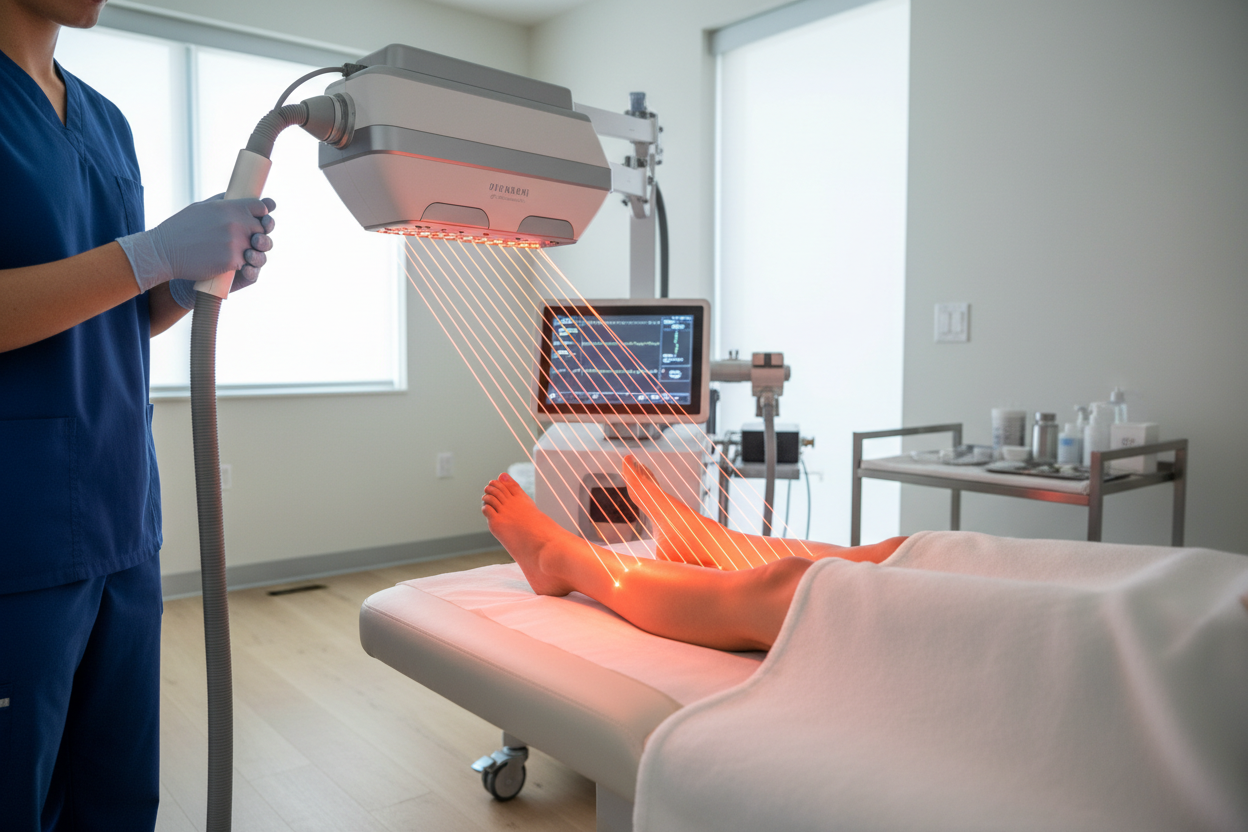
BIOFLEX vs Theralase: Which Professional Laser Therapy System Wins in 2026?
If you're comparing BIOFLEX vs Theralase, you already know you're looking at two of the most respected names in professional low-level laser therapy (LLLT). Both systems have decades of clinical use behind them. Both are trusted by licensed healthcare practitioners. And both cost serious money — which means choosing the wrong one is an expensive mistake.
This guide breaks down the real differences: technology, clinical outcomes, treatment versatility, ease of use, and total cost of ownership. Whether you're a clinic owner evaluating equipment or a serious patient researching your options, here's what you need to know before you commit.
Ready to Upgrade Your Recovery?
The equipment referenced in this guide, in stock and ready to ship. Many products qualify for HSA/FSA — call us to confirm eligibility for your situation.
Questions? Talk to our recovery specialists: (612) 360-2490
About the Author: Justin Webster is the founder of Your Health Sanctuary, a Minneapolis-based clinical recovery equipment retailer specializing in professional-grade laser therapy, red light therapy, and advanced recovery systems. Justin has evaluated BIOFLEX, Theralase, K-Laser, and Erchonia systems firsthand and works directly with clinics to match practitioners with the right technology for their patient populations.
Quick Answer: BIOFLEX vs Theralase at a Glance
BIOFLEX uses a dual-wavelength superluminous diode (SLD) array — delivering broad-area, consistent photobiomodulation with its patented flexible pad system. It's designed for high patient volume, ease of use, and a reproducible clinical protocol. Theralase uses a single-point laser probe delivering focused, deep-penetrating energy to targeted anatomical sites. It excels at acute, localized injuries in a clinic setting with a trained operator.
The bottom line: BIOFLEX is built for consistent, scalable clinical throughput. Theralase is built for targeted, operator-guided precision. The right choice depends entirely on your patient population and practice model.
BIOFLEX vs Theralase: Full Comparison Table
| Feature | BIOFLEX MultiPort | Theralase TLC-2000 |
|---|---|---|
| Technology | Superluminous diodes (SLDs) + laser probes | Single-point laser probe |
| Wavelengths | 660 nm + 830 nm (dual, simultaneous) | 660 nm + 905 nm |
| Delivery Method | Flexible SLD pads — covers large areas hands-free | Handheld probe — operator must guide treatment |
| Treatment Time | 20–45 min (hands-free, multitasking possible) | 5–20 min (operator attention required) |
| Patient Volume | High — multiple patients treated simultaneously | One patient at a time per operator |
| FDA Status | FDA cleared (Class II medical device) | FDA cleared (Class III) |
| Best For | Chronic pain, neuropathy, arthritis, broad-area healing | Acute injuries, localized joint pain, post-surgical |
| Clinical Evidence | 50+ published studies across 30+ years | Multiple peer-reviewed studies, ACE Clinical Trial |
| Home Use Availability | BIOFLEX Personal (home-use model available) | Clinic-only (no home model) |
| Starting Price | $28,400 (MultiPort) — financing available | ~$15,000–$25,000 depending on configuration |
Technology Deep Dive: How They Actually Work
BIOFLEX: The Superluminous Diode Advantage
BIOFLEX Laser Therapy systems combine two light delivery technologies in one protocol: superluminous diodes (SLDs) and laser probes. The SLD pads deliver broad-area, low-intensity photobiomodulation across the entire treatment zone simultaneously. The laser probe then targets deeper structures at the same dual wavelengths (660 nm red + 830 nm near-infrared).
According to a 2023 systematic review published in Photobiomodulation, Photomedicine, and Laser Surgery, dual-wavelength protocols targeting both superficial and deep tissue layers produced significantly better outcomes for chronic musculoskeletal pain than single-wavelength approaches. BIOFLEX's patented MultiPort system can treat up to six body sites simultaneously.
Theralase: Precision Laser Delivery
Theralase takes a different approach. The TLC-2000 uses a single-point handheld probe delivering focused laser energy to specific anatomical targets. Theralase uses a combination of 660 nm (visible red) and 905 nm (super-pulsed near-infrared) wavelengths, with the 905 nm super-pulsed laser offering exceptional penetration depth — up to 4–5 inches into tissue.
The ACE Clinical Trial demonstrated Theralase's capacity to stimulate chondrocyte proliferation in cartilage tissue — a significant finding for osteoarthritis patients that has supported the system's clinical reputation in orthopedic rehabilitation settings.
Which Conditions Does Each System Treat Best?
Where BIOFLEX Excels
- Chronic pain conditions — fibromyalgia, low back pain, chronic neuropathy
- Diabetic peripheral neuropathy — multiple studies support BIOFLEX protocols for nerve regeneration
- Osteoarthritis — especially hip and knee where broad coverage is beneficial
- Post-surgical healing — wound healing acceleration over large surgical sites
- High-volume clinic settings — where multiple patients need simultaneous treatment
Where Theralase Excels
- Acute sports injuries — targeted treatment of a specific sprained ligament or muscle tear
- Localized joint pain — knee, shoulder, wrist where single-point precision matters
- Trigger point therapy — precise probe placement addresses specific myofascial points
- Dental and oral applications — Theralase has specific protocols for TMJ and oral pain
Which System Fits Your Practice?
Choose BIOFLEX if: You run a high-volume practice — chiropractic, physical therapy, or integrative medicine — where throughput matters. The hands-free pad system allows your team to treat one patient while you work with another. If your patient base skews toward chronic pain, neuropathy, or arthritis, BIOFLEX's protocol-driven approach makes consistent outcomes easier to achieve.
Choose Theralase if: You're running a more boutique or specialized practice where a trained operator can dedicate focused attention to each treatment session. If your caseload is primarily acute injuries — sports medicine, orthopedic rehab, post-surgical — Theralase's precision energy delivery and deep penetration depth may produce faster results.
Cost Comparison: What You're Actually Investing
The BIOFLEX MultiPort System is priced at $28,400 and includes the full MultiPort console, up to six SLD pad arrays, a laser probe, all connection cables, clinical protocol software, and comprehensive training. BIOFLEX also includes ongoing clinical support — their medical team is available to review patient cases and recommend protocol adjustments.
Theralase's TLC-2000 typically runs $15,000–$25,000 depending on the probe configuration. When evaluating ROI, factor in treatment capacity. A BIOFLEX MultiPort treating four patients simultaneously at $75–$150 per session generates significantly more revenue per hour than a single-probe system.
Many post-surgical patients using BIOFLEX also benefit from pairing laser therapy with cold compression recovery. See the Game Ready GRPro 2.1 for a complete post-surgical recovery protocol.
Ready to Bring BIOFLEX Into Your Practice?
Your Health Sanctuary is an authorized BIOFLEX retailer. We can walk you through the full system, answer clinical questions, and help you evaluate the right configuration for your patient population.
📞 Call us: (612) 360-2490
Related Reading
- BIOFLEX vs K-Laser: Which Professional Laser System Is Right for Your Clinic?
- Laser Therapy vs Red Light Therapy: What's Actually Different and How to Choose in 2026
Frequently Asked Questions: BIOFLEX vs Theralase
Is BIOFLEX or Theralase better for chronic pain?
BIOFLEX has the stronger evidence base and broader clinical protocols for chronic pain management. Its dual-wavelength, broad-area delivery is particularly well-suited for conditions like fibromyalgia, chronic low back pain, and diabetic neuropathy. Theralase excels more for acute, localized pain conditions.
Can patients use BIOFLEX at home?
Yes. BIOFLEX offers a Personal home-use model alongside its professional clinical systems. Theralase does not currently offer a home-use version — it is exclusively a clinic device requiring trained operator administration.
Is BIOFLEX FDA cleared?
Yes. BIOFLEX systems are FDA cleared as Class II medical devices for pain relief, adjunctive treatment of post-surgical pain, and musculoskeletal conditions. Theralase TLC-2000 is FDA cleared as a Class III device. Both are legal for use by licensed healthcare practitioners in the United States.
What is the difference between BIOFLEX and Theralase wavelengths?
BIOFLEX uses 660 nm (visible red) and 830 nm (near-infrared) simultaneously. The 830 nm wavelength penetrates to approximately 2–3 inches of tissue depth. Theralase uses 660 nm and 905 nm (super-pulsed near-infrared), with the 905 nm wavelength achieving greater penetration depth — up to 4–5 inches — making it advantageous for deeper joint structures.
The Bottom Line: BIOFLEX vs Theralase
In the BIOFLEX vs Theralase comparison, both systems earn their reputations. BIOFLEX wins on clinical volume, hands-free delivery, comprehensive protocol support, and the breadth of its evidence base. Theralase wins on penetration depth and precision for acute, localized injuries in operator-guided settings.
Questions about which system is right for your specific patient population? Call us at (612) 360-2490 — we're happy to walk through the clinical details with you.
Not Sure Which Device Is Right for You?
Take the 4-Question Device Quiz
4 quick questions. We will match you to the clinician-trusted device built for your exact situation — and Justin reviews every submission personally.
Find My Device →

.%20Both%20systems%20have%20decades%20of%20...)