
Red Light Therapy for Diabetic Neuropathy: What the Clinical Evidence Shows
Red Light Therapy for Diabetic Neuropathy: What the Clinical Evidence Shows
Nearly half of all people living with diabetes will develop peripheral neuropathy — the burning, tingling, or complete numbness that typically starts in the feet and hands and slowly works its way inward. If you’ve sat across from a doctor who handed you a gabapentin prescription and called it a day, you know how hollow that answer feels. The medication may dull the pain, but it doesn’t address what’s actually happening in your nerve tissue. Red light therapy for diabetic neuropathy takes a fundamentally different approach: it targets the mitochondrial dysfunction and impaired microcirculation at the root of nerve damage, rather than masking the signal. Systematic reviews of photobiomodulation (PBM) therapy have reported clinically significant reductions in neuropathy pain scores and improved vibration perception in diabetic patients across multiple randomized controlled trials. Justin Webster has spent years working alongside MDs in clinical settings and has seen firsthand why clinicians are increasingly incorporating medical-grade red light into neuropathy protocols — not as a replacement for medical care, but as a targeted tool that addresses mechanisms no pill can reach.
What Is Actually Happening in Diabetic Peripheral Neuropathy
Before you can understand why red light works, you need to understand what’s going wrong. Diabetic peripheral neuropathy is driven by two intertwined problems: mitochondrial dysfunction and microvascular damage.
Mitochondrial Failure in Nerve Cells
Nerve cells are extraordinarily energy-hungry. Sustained high blood glucose creates an excess of reactive oxygen species (ROS) inside neurons — essentially cellular exhaust that overwhelms the mitochondria. When the mitochondria can’t generate enough ATP to maintain the sodium-potassium pumps that keep nerve cells firing correctly, you get the characteristic burning, tingling, and loss of sensation of peripheral neuropathy. Over time, without intervention, the nerve fiber density literally decreases — measurable on skin punch biopsy.
Microvascular Compromise
The vasa nervorum — the tiny blood vessels that supply your peripheral nerves — are among the first casualties of chronic hyperglycemia. When nerve blood supply is compromised, the mitochondrial problem compounds: less oxygen and fewer nutrients delivered to already-struggling nerve cells. Gabapentin and similar drugs interrupt the pain signal but do nothing to restore microvascular blood flow or mitochondrial function. That’s why neuropathy typically progresses even in medicated patients.
How Red Light Therapy Addresses the Root Mechanisms
Photobiomodulation at wavelengths of 630–880nm targets cytochrome c oxidase (CCO), the primary photoreceptor in the mitochondrial electron transport chain. When CCO absorbs red and near-infrared photons, it dissociates from inhibitory nitric oxide, restoring electron transport and boosting ATP synthesis. The clinical effects relevant to neuropathy are direct:
- ATP restoration: Nerve cells get the energy needed to maintain ion channel function and axonal transport.
- Nitric oxide (NO) release: Localized NO release from irradiated tissue dilates the vasa nervorum, improving blood flow to compromised nerves.
- Reduced oxidative stress: PBM upregulates antioxidant enzymes including superoxide dismutase and catalase, directly countering the ROS burden from chronic hyperglycemia.
- Nerve regeneration signals: Studies using skin punch biopsies have documented increased intraepidermal nerve fiber density following PBM treatment in neuropathy patients — measurable structural repair, not just symptom management.
What the Clinical Research Actually Shows
The evidence base for PBM and diabetic neuropathy has matured considerably since the early pilot studies. Here’s what the current literature supports:
Pain Reduction
Multiple randomized controlled trials have demonstrated significant pain reduction on validated scales (VAS, NPSI) compared to sham treatment. A frequently cited 2015 study by Khamseh et al. in Photomedicine and Laser Surgery found statistically significant improvements in pain, vibration sense, and thermal sensitivity in type 2 diabetic patients treated with 830nm LLLT over 10 sessions. Khamseh ME et al. The effect of low-level laser therapy on symptomatic diabetic peripheral neuropathy. Photomedicine and Laser Surgery. 2015;33(5):258-262.
Improved Nerve Conduction
Electromyography (EMG) and nerve conduction velocity (NCV) studies have shown measurable improvements in sensory and motor nerve conduction after PBM treatment — objective data that goes beyond patient-reported outcomes and is difficult to explain as placebo effect.
Wound Healing Benefit
For diabetic patients dealing with neuropathic foot ulcers, red light therapy’s documented acceleration of wound healing (via upregulation of fibroblast activity and VEGF expression) provides a secondary benefit that is especially clinically relevant. The FDA has cleared specific red light therapy systems for both pain management and wound healing in the US.
HealthLight vs. Consumer Red Light Panels: Why the Clinical Grade Difference Matters
If you’ve searched for red light therapy products, you’ve encountered a sea of consumer panels ranging from $50 to $500. For cosmetic applications, some of these work adequately. For diabetic neuropathy — a medical condition requiring tissue penetration into peripheral nerve fibers — the difference between a consumer device and a medical-grade system like the HealthLight Ultimate Body Kit is clinically significant.
| Feature | HealthLight Ultimate Body Kit | Typical Consumer Panel |
|---|---|---|
| Wavelengths | 660nm red + 880nm near-infrared | Often 630–660nm only (insufficient penetration) |
| Power density (irradiance) | Medical-grade; clinically validated dose range | Frequently underpowered; actual output often not disclosed |
| FDA clearance | FDA cleared for pain relief, muscle relaxation, increased local circulation | Most are FDA registered (not cleared) — different regulatory standard |
| Treatment coverage | Full-body pads — wraps around feet, calves, lower legs where neuropathy concentrates | Fixed panel — difficult to target extremities with consistent contact |
| Clinical protocol backing | Designed around validated clinical dosing protocols | No standardized clinical protocol included |
| HSA/FSA eligibility | Eligible through Truemed at checkout (est. 30–40% tax savings) | Typically not eligible |
| Best for | Diabetic patients, clinical settings, home use with medical supervision | General wellness, skin applications |
The 880nm near-infrared wavelength is not cosmetic — it penetrates 3–4cm into tissue, reaching the depth where peripheral nerve fibers and the vasa nervorum reside. Most consumer panels don’t include true 880nm NIR, or include it at irradiance levels too low to drive photobiomodulation at that depth. This is where clinical-grade matters most.
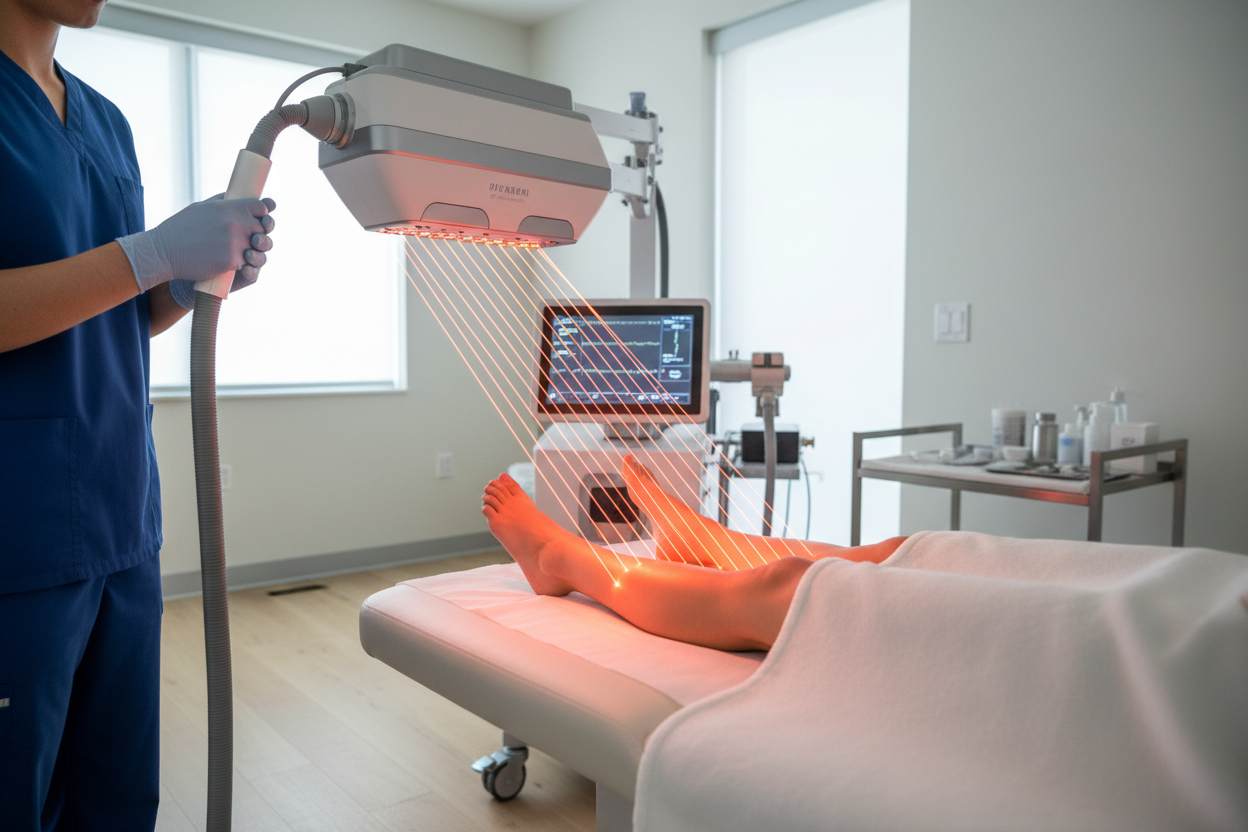
For patients dealing with the combination of neuropathy and chronic musculoskeletal pain, laser therapy systems like the BIOFLEX MultiPort System provide an alternative clinical approach using cold laser (PBMT) technology — also FDA-cleared and studied in neuropathy populations.
How to Use Red Light Therapy for Diabetic Neuropathy at Home
If your physician has approved red light therapy as part of your neuropathy management plan, here is the general protocol framework used in clinical settings:
- Frequency: 5 sessions per week for the first 4 weeks; 3 sessions per week for maintenance
- Session length: 20–30 minutes per treatment area (typically feet and lower legs for diabetic peripheral neuropathy)
- Direct contact: Flexible pad-style systems like HealthLight provide consistent tissue contact — superior to standing in front of a panel for extremity treatment
- Consistency over intensity: PBM is a dose-dependent therapy. Consistent sessions over 8–12 weeks show better outcomes than occasional intensive use
- Monitor sensation changes: Keep a symptom log tracking pain scores, areas of numbness, and any changes in sensation — this data is valuable for your care team
Frequently Asked Questions: Red Light Therapy for Diabetic Neuropathy
How many red light therapy sessions does it take to notice improvement in neuropathy symptoms?
Most clinical protocols run 10–20 sessions before a formal reassessment. Many patients report reductions in burning pain and improved sleep within the first 2–3 weeks of consistent use (5 sessions/week). Objective improvements in nerve conduction velocity have been documented at the 4–6 week mark in RCT settings. Expect 8–12 weeks for the most meaningful results.
Is red light therapy safe for people with diabetes?
Red light therapy is generally considered safe for diabetic patients when used as directed. Because diabetes can impair sensation, care should be taken to ensure the device is not producing excessive heat — though medical-grade LED-based systems like HealthLight produce minimal heat by design. Always consult your physician before starting any new therapy if you have active foot ulcers, peripheral arterial disease, or are on photosensitizing medications.
Does red light therapy help with diabetic neuropathy pain specifically, or just overall wellness?
The research specifically targets neuropathy pain outcomes — not general wellness metrics. Clinical studies have used validated neuropathy-specific pain scales (NPSI, VAS for neuropathic pain) and have documented statistically significant reductions in burning pain, stabbing pain, and allodynia in diabetic peripheral neuropathy patients. The mechanism is specific to nerve cell mitochondria and microvascular function, not a generalized effect.
Can I use red light therapy on my feet if I have open diabetic ulcers?
Red light therapy has a strong evidence base for wound healing specifically in diabetic foot ulcers. However, you should work with your wound care team before applying any device to an open wound. They can recommend appropriate wound dressings that are compatible with light therapy and ensure the treatment is coordinated with your overall wound care protocol.
Is the HealthLight system HSA or FSA eligible?
Yes. The HealthLight Ultimate Body Kit is eligible for purchase with HSA or FSA funds through the Truemed program available at checkout on Your Health Sanctuary. For most users, this represents a 30–40% effective discount compared to paying out of pocket. Medical-grade red light therapy for pain relief is a qualified HSA/FSA medical expense — consumer wellness panels typically are not.
How does HealthLight compare to the BIOFLEX laser system for neuropathy?
Both use photobiomodulation principles but deliver energy differently. HealthLight uses LED-based red and near-infrared light delivered through flexible pads — ideal for at-home use with consistent extremity contact. The BIOFLEX MultiPort System uses coherent cold laser, which is the standard in clinical and chiropractic settings. BIOFLEX is typically a practitioner-level device. For home use targeting diabetic neuropathy of the feet and lower legs, HealthLight’s pad-style design provides a practical advantage.
Ready to Try Medical-Grade Red Light Therapy?
The HealthLight Ultimate Body Kit is an FDA-cleared medical-grade system designed for exactly this application — flexible pads that wrap your feet and lower legs, delivering clinically validated 660nm and 880nm wavelengths at the right irradiance to drive photobiomodulation where diabetic neuropathy strikes hardest. For clinicians and patients exploring laser therapy, the BIOFLEX MultiPort System provides the professional cold laser alternative. Both are HSA/FSA eligible through Truemed at checkout.
Questions about which system fits your situation? Call us: (612) 360-2490. If you’ve been managing diabetic neuropathy and are ready for an approach that addresses the underlying mechanisms — not just the symptoms — these are the tools clinicians trust.
Shop HealthLight Ultimate Body Kit Explore BIOFLEX MultiPort System
Internal resources: Red Light Therapy for Neuropathy: Complete 2026 Guide | Infrared Light Therapy for Joint Pain | Medical Grade vs Consumer Red Light Therapy | HealthLight vs Bioflex Comparison