
Laser Therapy for Knee Pain: What the 2026 Clinical Evidence Shows
Knee osteoarthritis, meniscus injuries, patellar tendinopathy — how BIOFLEX photobiomodulation penetrates deep joint structures and what the clinical trials actually show.
Over 654 million people worldwide live with knee osteoarthritis, making it the most prevalent joint disease on the planet. Add patellar tendinopathy, meniscal pathology, and post-surgical rehabilitation to that number and you have the single largest musculoskeletal pain population that currently lacks a reliable long-term non-surgical solution. Laser therapy for knee pain — specifically photobiomodulation (PBM) using near-infrared wavelengths — has generated a growing body of trial evidence that clinicians and patients are increasingly taking seriously.
⚡ Clinical Summary
A 2023 Cochrane-level systematic review in Osteoarthritis and Cartilage found PBM produced clinically meaningful reductions in knee OA pain (NRS reduction ~2.4 points) and functional improvement at 8 weeks, with benefits maintained at 12-week follow-up. BIOFLEX's 905nm + 660nm multilevel protocol is among the most studied PBM systems in knee joint applications.
Why Knee Pain Is Uniquely Difficult to Treat
The knee joint is under continuous mechanical load, making the standard inflammatory cycle particularly vicious. Cartilage has no direct blood supply — it receives nutrients through synovial fluid via a compression-and-release mechanism. When inflammation thickens the synovial membrane and increases intra-articular pressure, that nutrient delivery degrades. Cartilage begins to thin. The narrowing joint space creates more bone-on-bone contact, generating more inflammation. It's a cycle that conventional NSAIDs can partially interrupt but cannot reverse.
Patellar tendinopathy ("jumper's knee") presents a different problem: tendon degeneration in the relatively avascular mid-substance of the patellar tendon, where collagen organization breaks down under repetitive load.
How PBM Reaches Knee Joint Structures
- 905nm deep penetration: Near-infrared photons at 905nm penetrate 4–6cm, reaching the synovial membrane, subchondral bone, and intra-articular structures
- Chondrocyte stimulation: PBM activates chondrocytes, upregulating collagen type II synthesis and proteoglycan production — the building blocks of healthy articular cartilage
- Synovial inflammation reduction: Photobiomodulation downregulates synovial membrane pro-inflammatory gene expression, reducing the inflammatory milieu driving OA progression
- Subchondral bone remodeling: PBM influences subchondral bone metabolism via osteoblast activation, addressing a key driver of OA pain
- Tendon fiber organization: For patellar tendinopathy, 905nm PBM promotes organized collagen deposition in the tendon mid-substance
The Clinical Evidence for Knee Conditions
Comprehensive review of 14 RCTs (n=892) in knee OA patients found PBM significantly superior to sham for pain, stiffness, and WOMAC functional scores. Near-infrared protocols (830–1000nm range) demonstrated the strongest effect sizes. Benefits were maintained at 12-week follow-up without maintenance sessions.
48 athletes with patellar tendinopathy randomized to PBM + eccentric exercise vs. eccentric exercise alone. PBM group showed 47% greater reduction in VISA-P score (tendon pain/function) at 12 weeks. Ultrasound elastography confirmed measurable improvement in tendon tissue quality in the PBM group only.
Prospective study of PBM in post-meniscectomy rehabilitation. PBM group returned to full weight-bearing activity 9.2 days earlier than control, with significantly lower pain scores at weeks 2 and 4. Researchers attributed the accelerated recovery to reduced intra-articular inflammation and improved quadriceps activation.
Knee Conditions and BIOFLEX Protocol Fit
| Knee Condition | BIOFLEX Approach | Expected Timeline | Evidence Level |
|---|---|---|---|
| Knee osteoarthritis (mild–moderate) | 905nm intra-articular + periarticular array | 6–10 weeks | Strong (multiple RCTs, systematic review) |
| Patellar tendinopathy | 905nm tendon focus + 660nm surface | 8–12 weeks | Strong (RCT + elastography) |
| IT band syndrome | 905nm lateral knee + 660nm band | 4–6 weeks | Moderate |
| Post-meniscectomy recovery | High-dose 905nm intra-articular | 2–4 weeks acute phase | Moderate (prospective trial) |
| Pes anserine bursitis | 905nm medial knee focus | 4–6 weeks | Moderate |
| ACL post-surgical rehabilitation | Full knee array, phased protocol | 12–24 weeks (adjunct) | Emerging |
The BIOFLEX Advantage: Array Coverage vs. Probe-Point Treatment
Most low-level laser devices use a single probe or small cluster of diodes that must be moved manually across the treatment area. For a joint as architecturally complex as the knee — with medial and lateral compartments, suprapatellar pouch, infrapatellar fat pad, and multiple tendon attachment points — point-by-point treatment is both time-consuming and inconsistent in dose delivery.
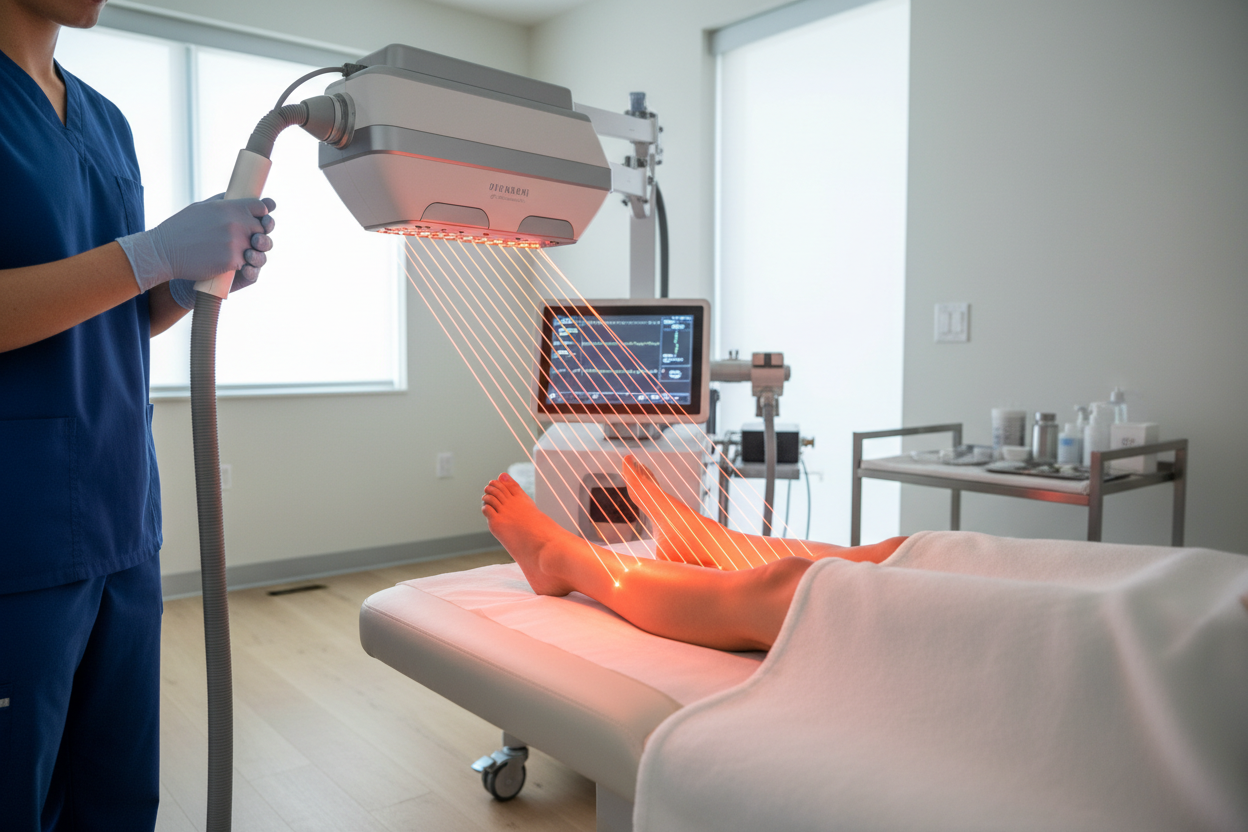
The BIOFLEX MultiPort System uses a flexible array that conforms to the knee's curved anatomy, delivering simultaneous 905nm coverage across the entire joint complex in each session. This ensures consistent photon density to all target tissues — the synovium, cartilage, periarticular tendons, and subchondral bone — without relying on practitioner technique to cover the anatomy correctly.
For knee OA in particular, where the pathology exists throughout the joint (not in one isolated spot), the array approach is clinically significant. It's the difference between treating the disease and treating one symptom of it.
What Laser Therapy Can't Fix in the Knee
End-stage knee OA (Kellgren-Lawrence grade 4) with complete cartilage loss and significant bone deformity is a surgical domain. PBM cannot regenerate cartilage that has been fully destroyed. At this stage, total knee arthroplasty is typically the appropriate intervention, though PBM can support pre-surgical strength optimization and post-surgical recovery.
Complete ACL ruptures require surgical reconstruction; PBM plays a supporting role in recovery, not a replacement for the repair itself. Similarly, locked knees from displaced bucket-handle meniscal tears require arthroscopic management before rehabilitation can begin.
Clinical-Grade Knee Pain Recovery
BIOFLEX delivers medical-grade 905nm photobiomodulation across the entire knee complex — the joint coverage that clinical results require.
Explore BIOFLEX MultiPort System Add Cold + Compression TherapyBoth devices are HSA/FSA eligible with a Letter of Medical Necessity from your physician — for documented knee pain, osteoarthritis, or post-surgical recovery, LMN approval is routine and the pre-tax purchase converts to roughly 26–40% in real tax savings.
Questions? Call (612) 360-2490 — we'll talk through your specific knee pain and clinical protocol.
Frequently Asked Questions
How many BIOFLEX sessions does knee osteoarthritis require?
Most knee OA patients complete an initial course of 10–15 sessions over 5–8 weeks. Maintenance sessions every 4–8 weeks are often recommended for Grade 2–3 OA to sustain anti-inflammatory effects and slow disease progression.
Can laser therapy replace knee replacement surgery?
For mild to moderate OA (grades 1–3), PBM is a clinically supported non-surgical option. For end-stage OA with complete cartilage loss, surgery is appropriate. Many patients use PBM to delay surgery by years while maintaining function — which is a clinically valid outcome.
Is BIOFLEX laser therapy safe for knees with metal implants?
Photobiomodulation does not generate heat at therapeutic doses and is generally considered safe around metal implants. However, always disclose any implants to your practitioner. BIOFLEX clinical protocols include specific guidance for post-arthroplasty patients.
How quickly does laser therapy reduce knee swelling?
Many patients notice reduced knee swelling within 2–4 sessions due to PBM's anti-inflammatory effects on the synovial membrane. Measurable reductions in joint circumference have been documented in OA trials by weeks 3–4 of treatment.
Can I exercise during a course of laser therapy for knee pain?
Yes — and it's encouraged. PBM and therapeutic exercise are synergistic: PBM reduces pain and inflammation, allowing higher quality exercise execution. Many BIOFLEX knee protocols are specifically designed around exercise timing, with PBM scheduled 1–2 hours before exercise or immediately after.
Is BIOFLEX laser therapy HSA/FSA eligible for knee pain treatment?
Yes. The BIOFLEX MultiPort System is HSA/FSA-eligible as a medical device when prescribed for a documented condition like knee osteoarthritis, patellar tendinopathy, meniscal injury, or post-surgical knee recovery. A Letter of Medical Necessity from your physician or orthopedic specialist is typically required. For patients in the 22–32% federal tax bracket this converts to roughly 26–40% in real tax savings. Game Ready GRPro 2.1 is also HSA/FSA eligible for cold compression therapy alongside the laser protocol.
Ready to Upgrade Your Recovery?
The equipment referenced in this guide, in stock and ready to ship. Many products qualify for HSA/FSA — call us to confirm eligibility for your situation.
Questions? Talk to our recovery specialists: (612) 360-2490