
BIOFLEX vs Multi Radiance: Which Cold Laser System Wins in 2026?
A head-to-head clinical comparison of the two most specified professional laser therapy systems in North American clinics
If you've spent time researching professional cold laser therapy equipment, you've almost certainly come across both BIOFLEX Laser Therapy and Multi Radiance Medical. Both companies have earned serious clinical credibility. Both are specified by physiotherapists, sports medicine physicians, and rehabilitation clinics across North America. And both will cost you more than most consumer devices combined.
So which system actually wins the clinical performance comparison in 2026? We've done the deep research. Here's what separates them — and which one belongs in your clinic or recovery setup.
The Core Technology: How They're Different
BIOFLEX: Sequential, Multi-Wavelength Protocol
BIOFLEX Laser Therapy systems use a sequential approach: superluminous diodes (SLD pads) at 660nm (red) followed by laser diodes at 830nm (near-infrared), then a concluding probe treatment at 905nm for the deepest tissue penetration available in non-surgical laser. This three-stage protocol mirrors the body's natural photobiomodulation response — surface tissue first, then progressively deeper.
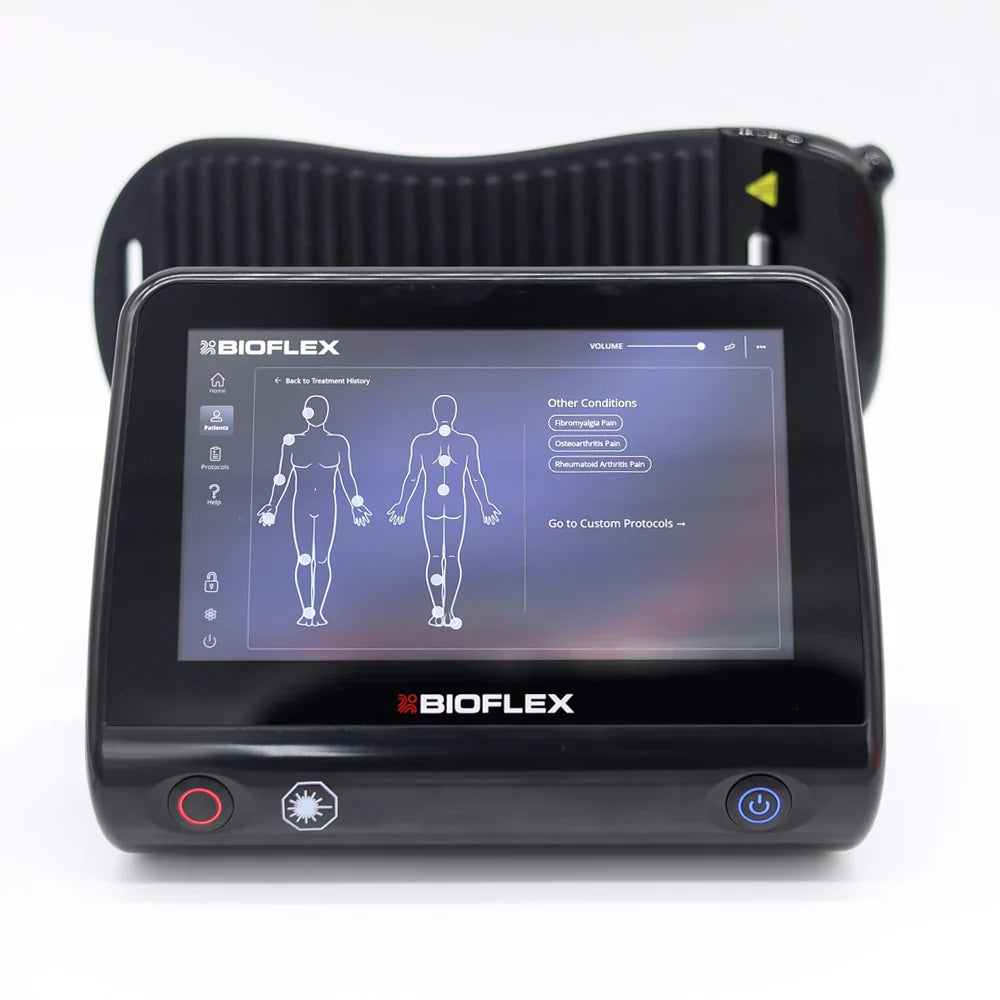
The flagship BIOFLEX MultiPort System allows simultaneous multi-site treatment with both SLD arrays and laser probes, making it one of the most versatile systems on the market for complex or bilateral cases.
Multi Radiance: High-Power, Multi-Radiant Energy
Multi Radiance Medical (makers of the MR4, TerraQuant, and ACTIVet systems) uses a proprietary "Super Pulsed" technology combining wavelengths at 905nm, 875nm, 660nm, and infrared simultaneously. Their Super Pulsed laser delivers peak power up to 50W in microsecond pulses — well above what continuous-wave lasers can deliver safely. This gives their devices excellent penetration without thermal damage risk.
The Multi Radiance approach is designed for speed: shorter treatment sessions, often 3–10 minutes per site. This is a meaningful advantage in high-volume clinical settings.
Head-to-Head Clinical Comparison
| Category | BIOFLEX | Multi Radiance | Edge |
|---|---|---|---|
| Primary Wavelengths | 660nm, 830nm, 905nm (sequential) | 905nm, 875nm, 660nm (simultaneous) | TIE |
| Treatment Depth | Up to 3–5cm (905nm probe) | Up to 3–5cm (Super Pulsed 905nm) | TIE |
| Protocol Flexibility | Extensive library: 150+ protocols by condition | Good: condition-specific settings built in | BIOFLEX |
| Multi-Site Simultaneous | Yes — MultiPort system | Single probe (tandem available) | BIOFLEX |
| Neuropathy Applications | Excellent — dedicated SLD pad protocols | Good — primarily probe-based | BIOFLEX |
| Session Speed | 15–30 min (thorough sequential protocol) | 3–10 min (high-power short sessions) | Multi Radiance |
| Portability | Tabletop (clinic-based) | Portable handheld (MR4, ACTIVet) | Multi Radiance |
| Clinical Evidence Volume | 40+ years, 1,500+ peer-reviewed studies cited | Strong, growing evidence base | BIOFLEX |
| FDA Clearance | FDA cleared (510(k)) | FDA cleared | TIE |
| Price Range | $8,000–$25,000+ (system dependent) | $4,000–$16,000+ | Multi Radiance |
| Best For | Complex chronic cases, neuropathy, arthritis | Acute pain, high-volume clinical throughput | Depends on use case |
Where BIOFLEX Has a Clear Edge
Neuropathy and Nerve-Related Conditions
For practitioners treating peripheral neuropathy, BIOFLEX's SLD pad approach is particularly effective. The large-surface array delivers low-level photons across the full treatment zone simultaneously, which is exactly what diffuse nerve damage requires. A 2023 systematic review in Photobiomodulation, Photomedicine, and Laser Surgery confirmed that low-level laser therapy at 830nm showed significant improvements in nerve conduction velocity and pain scores in diabetic peripheral neuropathy patients — the wavelength range where BIOFLEX specializes.
Multi-Site and Bilateral Treatment
The BIOFLEX MultiPort System allows a clinician to treat multiple body areas simultaneously — both knees, bilateral shoulders, or a full spinal segment — while the practitioner sees other patients. This is a major efficiency advantage in rehabilitation settings where chair time equals revenue. Multi Radiance requires sequential single-probe treatment for multi-site work.
Protocol Depth and Customization
BIOFLEX has spent four decades building condition-specific protocols. Their clinical library covers over 150 conditions with dosing parameters, treatment frequency, and progression guidelines validated by clinical outcomes data. For a physiotherapist or sports medicine physician who wants evidence-based protocols rather than dialing in settings from scratch, this library is invaluable.
Where Multi Radiance Has a Clear Edge
Speed and Throughput
If your practice sees high patient volume and needs treatments completed in under 10 minutes, Multi Radiance's Super Pulsed technology genuinely delivers. The high peak power in ultra-short pulses means photons reach deep tissue faster than low-power continuous-wave systems. For acute musculoskeletal injuries (sprains, strains, sports injuries), this efficiency is compelling.
Portability and Field Use
The Multi Radiance MR4 and ACTIVet systems are used by athletic trainers and sports teams precisely because they're portable and battery-operated. BIOFLEX is a tabletop clinic system — excellent for the treatment room, but not for the sideline.
Entry Price Point
Multi Radiance devices start at lower price points than full BIOFLEX system packages. For a solo practitioner or smaller clinic, this can be the deciding factor.
The Clinical Evidence Question
Both companies have legitimate clinical research supporting their technology. The critical distinction is evidence volume and longevity. BIOFLEX has been in clinical use since the 1980s, with peer-reviewed studies spanning four decades across musculoskeletal medicine, oncology supportive care, wound healing, and neurological applications. That body of evidence is simply larger and more diverse.
Multi Radiance's Super Pulsed technology is well-supported for pain management and acute injury applications. Their evidence base is growing strongly — but BIOFLEX's 40-year clinical track record is harder to match for practitioners who want the deepest possible evidence base for complex chronic cases.
Which Patients and Conditions Drive the Choice?
Choose BIOFLEX if your patient population includes:
- Peripheral neuropathy (diabetic, chemotherapy-induced, idiopathic)
- Chronic musculoskeletal conditions (osteoarthritis, tendinopathy, chronic low back pain)
- Post-surgical recovery requiring multi-site treatment
- Neurological and wound healing applications
- Cases requiring detailed, condition-specific protocols with documented outcomes
Choose Multi Radiance if your practice requires:
- High-volume throughput with short per-patient session times
- Portable or field-based treatment (athletic training, sports medicine sidelines)
- Acute sports injuries and soft tissue trauma as primary case load
- Lower initial capital investment with strong acute-pain results
The Home User and Serious Athlete Perspective
For home users — serious athletes recovering from surgery, chronic pain patients, or individuals managing ongoing conditions — the calculation is different. Multi Radiance handheld devices are more accessible for home use. But if you're investing at the professional level for a home recovery setup, the BIOFLEX system's clinical protocol library and multi-site capability make it the superior choice for complex or ongoing conditions.
Both the BIOFLEX MultiPort System and our Game Ready GRPro 2.1 represent the same philosophy: clinical-grade tools at home prices, used by the same practitioners who treat professional athletes.
BIOFLEX MultiPort System — Professional Cold Laser Therapy
The same system used in sports medicine clinics and physiotherapy practices across North America. Sequential multi-wavelength protocols. 150+ condition-specific treatment programs. FDA cleared.
View BIOFLEX MultiPort System → Call (612) 360-2490The BIOFLEX MultiPort System is HSA/FSA eligible with a Letter of Medical Necessity from your physician — for documented musculoskeletal conditions, chronic pain, post-surgical rehab, or sports injury recovery, LMN approval is routine and the pre-tax purchase converts to roughly 26–40% in real tax savings depending on your tax bracket.
The Bottom Line
BIOFLEX and Multi Radiance are both legitimate, clinically proven cold laser therapy systems. They're not competing with consumer red light panels or cheap massage devices — both belong in the same league of serious professional photobiomodulation equipment.
For chronic and complex conditions — neuropathy, arthritis, post-surgical recovery, multi-site treatment — BIOFLEX has the deeper clinical toolkit. The protocol library, sequential multi-wavelength approach, and multi-site capability give a practitioner more precision over a wider range of cases.
For high-volume acute care and portable applications, Multi Radiance's speed and portability are genuine competitive advantages.
At Your Health Sanctuary, we carry the BIOFLEX MultiPort System because it represents the best clinical ROI for the serious home user or professional integrating advanced laser therapy into a recovery program. Want to compare it to other systems? Read our BIOFLEX vs K-Laser breakdown and our Laser Therapy vs Red Light Therapy guide for the full context.
Frequently Asked Questions
For peripheral neuropathy, BIOFLEX has a clinical edge due to its SLD pad arrays, which deliver low-level photons across large diffuse treatment zones — ideal for the distributed nerve damage patterns in neuropathy. BIOFLEX also has more condition-specific neuropathy protocols backed by decades of clinical outcomes data.
BIOFLEX uses 660nm (red), 830nm (near-infrared), and 905nm in a sequential three-stage protocol. Multi Radiance uses 905nm, 875nm, and 660nm simultaneously in a Super Pulsed format. Both reach similar tissue depths, but BIOFLEX's sequential approach allows more targeted treatment at each depth layer.
BIOFLEX systems generally cost more upfront — full MultiPort systems range from $8,000 to $25,000+ depending on configuration. Multi Radiance devices start lower, from around $4,000 for handheld units. The price difference reflects BIOFLEX's multi-site capability and broader protocol library.
Yes. Both BIOFLEX and Multi Radiance devices are FDA cleared for use in the United States. FDA clearance means the devices have been reviewed for safety and efficacy and meet the agency's requirements for marketing as medical devices.
Both systems are primarily designed for clinical use by trained practitioners. The BIOFLEX MultiPort System is available for serious home users with appropriate guidance. We recommend consulting with a healthcare provider to develop a treatment protocol before using either system at home.
Yes. The BIOFLEX MultiPort System is HSA/FSA-eligible as an FDA-cleared medical device when prescribed for documented musculoskeletal conditions, chronic pain, sports injury recovery, or post-surgical rehabilitation. A Letter of Medical Necessity from your physician or physical therapist is typically required, converting the pre-tax purchase to roughly 26–40% in real tax savings depending on your tax bracket.