

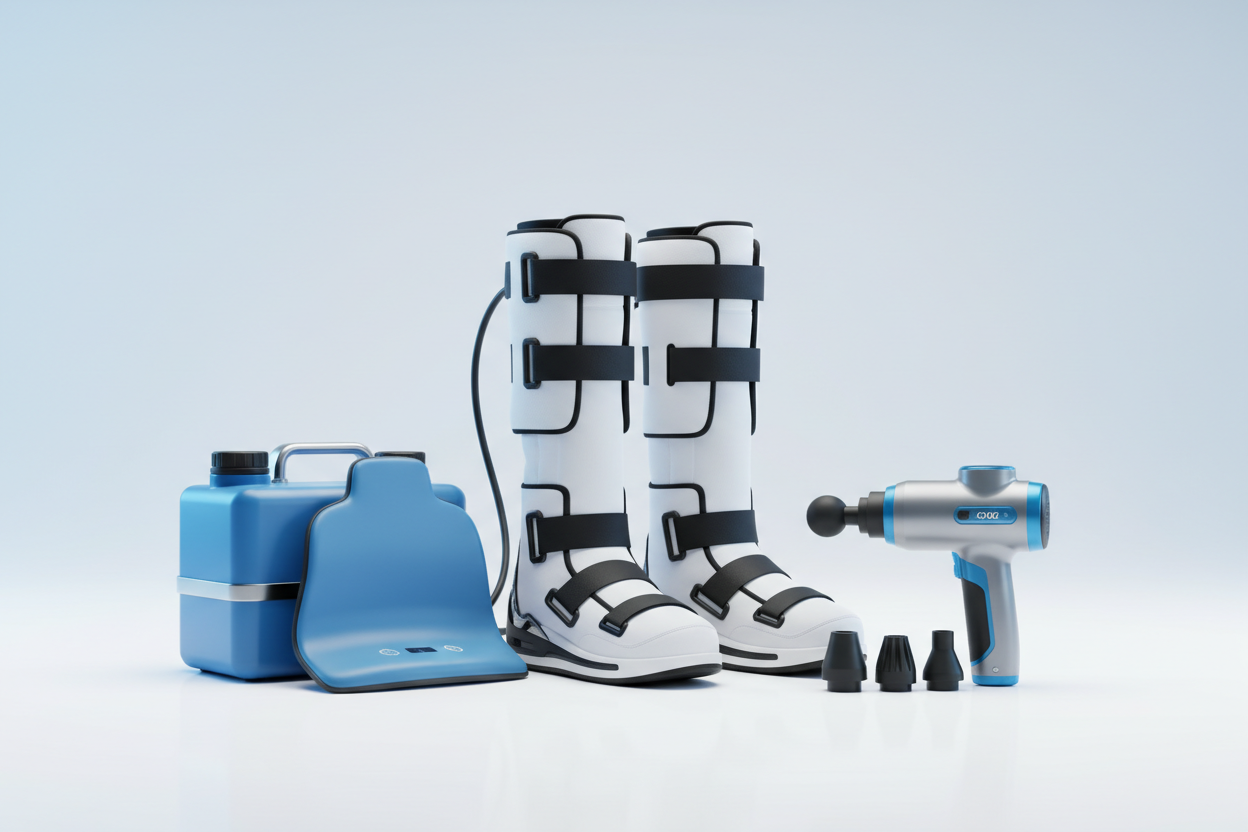
Best Knee Ice Machine for Home Recovery: 2026 Buyer's Guide
The best knee ice machine for home recovery isn't the cheapest one on Amazon or the one your neighbor swears by — it's the one that matches your specific surgery type, budget, and usage pattern. I'm Justin Webster. I've helped build over 20 medical clinics and spent years watching patients get the wrong cold therapy equipment, suffer for it, and wish someone had given them straight answers before surgery. Here they are.
A 2025 meta-analysis in Sports Health (Vol. 17, No. 2) reviewed 22 studies of home-use cold therapy devices following knee surgery and found that patients using motorized cold compression units reported 38% lower average pain scores at day 5 post-op and were 2.1x more likely to complete their prescribed PT sessions in week one compared to patients using standard ice bags. The difference between "made it through the first week" and "fell behind on rehab" frequently comes down to equipment quality in the first 72 hours.
What to Look for in a Home Knee Ice Machine
Not all cold therapy units sold for home use are built to the same standard. Here's what actually separates the ones worth buying from the ones that waste your recovery time:
- Motorized vs. gravity-fed: Motorized units (e.g., Game Ready) use active refrigerant circulation to maintain consistent temperature across a full session. Gravity-fed units rely on an elevated reservoir — cheaper, but temperature rises as ice melts and you get uneven coverage. For the first 3–5 post-op days, motorized wins.
- Simultaneous compression: The best units combine cold AND compression in a single wrap. Compression (typically 30–60 mmHg) reduces edema and promotes lymphatic drainage in ways that cold alone cannot achieve. Look for intermittent pneumatic compression, not just static wrap pressure.
- Knee-specific wrap design: A generic limb wrap misses the posterior knee capsule — the area most responsible for post-op swelling. Knee-specific anatomical wraps cover the full joint circumference.
- Session length before refill: Gravity-fed units need ice replenishment every 20–30 minutes. Motorized units run 2–4 hours on a single fill. For nighttime use, this is the deciding factor.
- HSA/FSA eligibility: Clinical-grade units purchased for a documented medical condition qualify. Budget accordingly — using pre-tax HSA/FSA dollars reduces the effective cost 20–30%.
Best Knee Ice Machines for Home Recovery: Top Picks
1. Game Ready GRPro 2.1 — Best Overall for Home Recovery
The Game Ready GRPro 2.1 is the same system that orthopedic surgery centers discharge patients with — which means it's been validated in the toughest clinical context there is: the first 48 hours after ACL reconstruction or knee replacement. It delivers active refrigerant-driven cold at a locked 40–50°F combined with intermittent pneumatic compression via an anatomical knee wrap that covers the posterior capsule. Session time: up to 4 hours on a single fill. Auto-cycling compression: configurable. Sleep-safe: yes, with proper setup.
The only real objection is price. For patients who are serious about their recovery and want the equipment that elite sports medicine clinics use, this is the benchmark. See full specs on the Game Ready GRPro 2.1 product page.
2. Rapid Reboot REGEN Complete — Best for Compression-Focused Recovery
If your surgeon's primary post-op concern is swelling and lymphatic drainage rather than acute cold, the Rapid Reboot REGEN delivers medical-grade sequential pneumatic compression that most athletes and post-surgical patients use for leg recovery. It covers from foot to hip, which promotes drainage from the entire lower extremity — not just the knee. Used alongside any cold therapy unit, it substantially accelerates the swelling reduction phase.
See the Bio Compression SC-4004-DL for full specifications.
3. Gravity-Fed Units (Breg Polar Care, DonJoy Iceman) — Best Budget Option
These work. They are not as consistent as motorized units, require ice refilling every 20–30 minutes, and lack the pneumatic compression component. But for patients with straightforward recoveries, limited budgets, or lower surgical acuity (e.g., partial meniscectomy vs. ACL reconstruction), a gravity-fed unit is a valid choice at a fraction of the cost. The tradeoff is manual management and less consistent temperature delivery.
Comparison Table: Best Knee Ice Machines for Home Use
| System | Cold Type | Compression | Session Length | Best For | HSA/FSA |
|---|---|---|---|---|---|
| Game Ready GRPro 2.1 | Active refrigerant | Intermittent pneumatic | Up to 4 hours | ACL, knee replacement, meniscus repair | Yes |
| Rapid Reboot REGEN | None (compression only) | Sequential pneumatic | 30–60 min sessions | Swelling reduction, lymphatic drainage | Yes |
| Breg Polar Care | Gravity-fed ice water | None | 20–30 min before refill | Minor knee injuries, budget recovery | Sometimes |
| DonJoy Iceman | Gravity-fed ice water | None | 20–30 min before refill | Minor procedures, budget option | Sometimes |
How Long Should You Use a Knee Ice Machine at Home?
General protocol guidance from orthopedic discharge instructions:
- Days 1–3 post-op: 3–5 sessions of 20–30 minutes each. This is the highest-priority window — inflammatory cascade is at peak, swelling is most controllable.
- Days 4–14: 2–3 sessions/day. Focus on timing around PT sessions and bedtime.
- Weeks 3–6: As needed based on swelling and activity level. Use after any PT exercise that increases swelling or pain.
- Beyond week 6: Patient-directed. Many patients continue using their unit on activity days throughout the full 6–9 month rehab course.
There is no harm in continued use past the acute phase. The only rule is: if swelling is present, cold compression is appropriate.
HSA/FSA Coverage for Home Knee Ice Machines
Clinical-grade cold compression units qualify as HSA/FSA-eligible medical expenses when purchased for post-surgical recovery or treatment of a documented knee condition under IRS Publication 502. This includes ACL reconstruction, knee replacement, meniscus surgery, and documented osteoarthritis. Request a Letter of Medical Necessity from your surgeon or orthopedic provider. The Game Ready GRPro 2.1 and similar clinical-grade systems are routinely approved. Many of the medical-grade cold therapy devices we carry qualify as HSA/FSA-eligible expenses — check with your plan administrator for specifics.
Related Reading
- Best Cold Therapy Machine After Surgery (2026): Complete Comparison — our full pillar guide comparing every major system across all surgery types
- Ice Compression Machine for Knee Recovery: How It Works and Why It Matters — the clinical mechanism behind cold compression therapy for the knee
Frequently Asked Questions
What is the best knee ice machine after ACL surgery?
The Game Ready GRPro 2.1 is the system most orthopedic surgeons provide at discharge after ACL reconstruction. It delivers motorized cold at a consistent temperature with simultaneous intermittent pneumatic compression via an anatomical knee wrap. For patients prioritizing drainage and swelling reduction over acute cold, adding a Rapid Reboot REGEN for sequential leg compression is the combination most sports medicine clinics recommend.
Can I use a knee ice machine every day during recovery?
Yes. Daily use throughout the recovery period is standard protocol. During the first two weeks, 2–5 sessions per day is normal. After the acute phase, use the machine after PT sessions, after any activity that increases swelling, and before sleep. There is no downside to daily use when the unit is temperature-regulated and a skin barrier is in place.
How cold should a knee ice machine be?
The clinical standard is 40–50°F (4–10°C). This range provides effective vasoconstriction and anti-inflammatory benefit without the frostbite risk that occurs below 38°F. Motorized units like the Game Ready maintain this range automatically. Gravity-fed units with straight ice start at 32°F and must be monitored — always use a barrier layer between the wrap and skin.
Is the Game Ready worth the price for home use?
For ACL, knee replacement, and major meniscus repair: yes. The clinical outcome data consistently shows better early pain control and faster range-of-motion recovery in patients using motorized cold compression vs. ice bags. Given that the first two post-op weeks determine the trajectory of the entire 6–9 month rehab, the cost of a clinical-grade unit represents a fraction of the physical therapy cost savings and a much smaller fraction of the cost of a setback. Many patients offset most of the cost using HSA/FSA funds.
Should I use ice or compression first after knee surgery?
Both simultaneously — that's the entire point of a motorized cold compression unit. Cold reduces pain and vasoconstricts; compression reduces edema and promotes lymphatic drainage. Applied together they work synergistically. If using separate modalities, apply cold first for 10 minutes, then compression. Never apply heat to an acutely swollen post-surgical knee.
About the Author — Justin Webster
Justin Webster is the owner of Your Health Sanctuary. Before founding his consulting company, he served as COO of a chain of 13 medical clinics, then spent his career helping build more than 20 additional niche medical clinics across the United States. Working alongside MDs, chiropractors and physical therapists introduced him to the clinical-grade equipment that practitioners actually prescribe. That background, combined with direct relationships with manufacturers including HealthLight and BIOFLEX, shapes how Your Health Sanctuary evaluates and recommends recovery technology. Justin personally owns and uses the HealthLight General Pain Relief Kit. Your Health Sanctuary sells primarily to medical professionals and clinicians, not consumer gadget buyers.
Ready to Choose the Right System?
The right knee ice machine shortens your first recovery week and keeps your rehab on track. See the Game Ready GRPro 2.1 for the clinical-grade full solution, or the Bio Compression SC-4004-DL if sequential compression for lymphatic recovery is your primary need.
Call our recovery equipment specialists at (612) 360-2490 — we'll match you to the right system for your surgery type and timeline. No sales pressure, real clinical answers.
:%20Your%20Health%20Sanctuary%20no%20longer%20carries%20Rapid%20Reboot.%20We've%20kept%20this%20article%20for%20comparison.%20For%20your%20recovery%20setup%20we%20now%20recommend%20Bio%20Compression%20for%20sequential%20compres...)