
Red Light Therapy Wound Healing: What 2026 Evidence Shows
A wound that won't close is one of the most frustrating things a person can face — and one of the most common reasons people start asking whether red light therapy wound healing is real medicine or marketing. The honest answer, backed by the research, is that it is real, with important caveats. A 2026 systematic review comparing LED and laser photobiomodulation in cutaneous wound healing (published in PMC, article PMC12809106) found that targeted red and near-infrared light consistently accelerated tissue repair across experimental models. When I was helping build niche medical clinics across the country, I watched MDs and wound-care nurses use this same principle — light at specific wavelengths feeding the cells that rebuild tissue. Most people never had access to that technology at home. This guide explains what the evidence actually supports, how the wavelengths work, and how to use a medical-grade device safely so a stubborn wound has the best chance to heal.
How Red Light Actually Helps a Wound Close
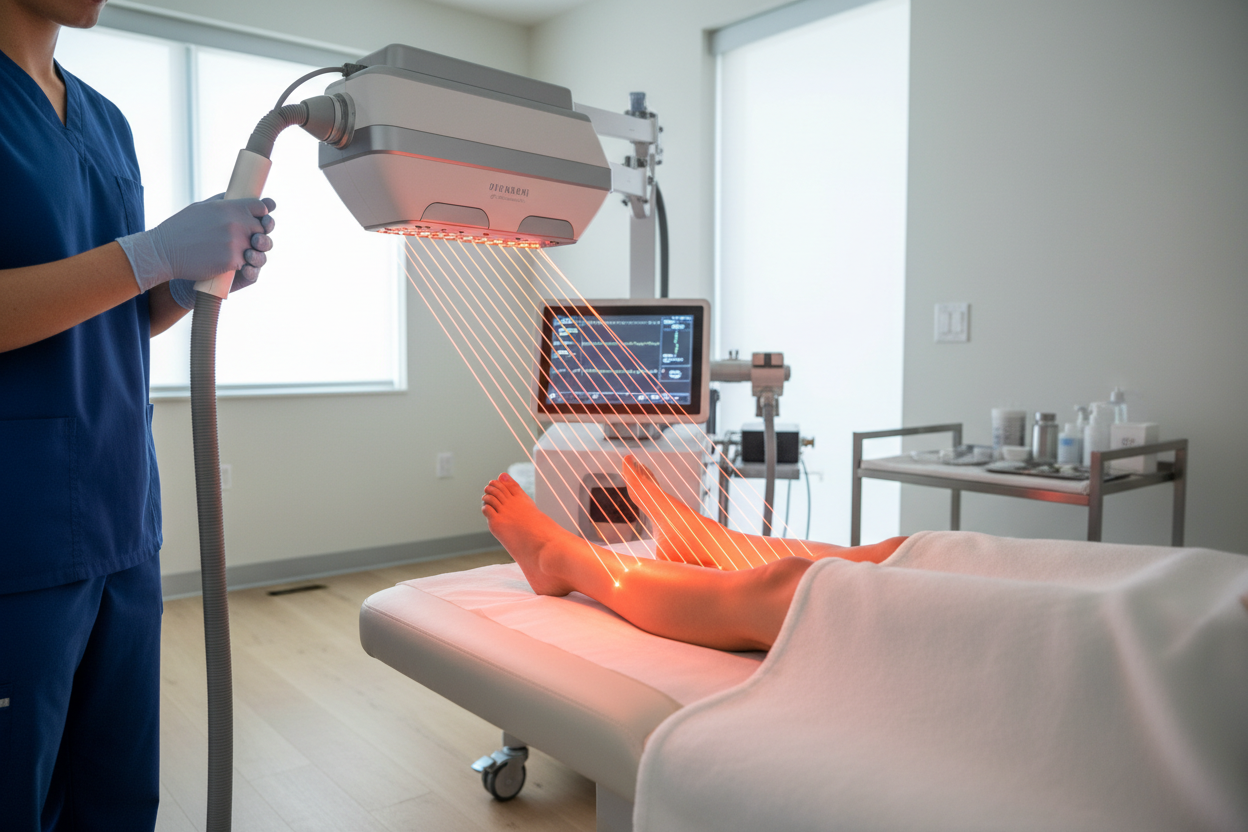
Photobiomodulation (PBM) is the clinical name for what most people call red light therapy. Red (typically 630–660 nm) and near-infrared (810–850 nm) light penetrate skin and are absorbed by cytochrome c oxidase, an enzyme in the mitochondria of your cells. That absorption increases cellular energy (ATP) production and nudges the repair process forward in three ways that matter for a wound.
1. More energy for the cells that rebuild tissue
Fibroblasts — the cells that lay down new collagen — work harder when their mitochondria have more fuel. Faster collagen deposition means a wound bed fills in and closes sooner.
2. Better local circulation
PBM promotes the formation of new small blood vessels (angiogenesis), delivering oxygen and nutrients to the wound margin. Poor circulation is the single biggest reason diabetic and pressure wounds stall, which is why this effect is so clinically valuable.
3. Calmer, more productive inflammation
Healing needs inflammation, but it needs the right amount. Red light helps modulate inflammatory signaling so the wound moves out of the stalled, chronically inflamed phase and into active repair. (Our deeper write-up on red light therapy for inflammation covers this mechanism in detail.)
What the 2026 Research Says — and Where It's Limited
The evidence base has grown quickly. Beyond the cutaneous wound-healing review above, a 2026 systematic review and meta-analysis on photobiomodulation for wound healing after episiotomy (PMC12897679) reported meaningful improvements in both wound closure and pain across the included trials. Earlier meta-analyses of randomized controlled trials reached the same direction of effect for skin wounds treated with LED and low-level laser light.
The caveats are just as important, and any clinician will tell you the same thing: results depend heavily on dose. Too little light does nothing; too much can blunt the benefit. Wavelength, power density, distance from the skin, and total treatment time all matter. This is the core reason a calibrated, FDA-cleared device tends to outperform a cheap panel of unknown output — a distinction we break down in our HealthLight Ultimate Body Kit review.
Choosing a Device: Medical-Grade Pad vs. Targeted Face Device
For wound healing specifically, coverage and contact matter. Flexible LED pads that wrap around a limb or sit against a wound area deliver consistent dosing where you need it, while a rigid facial device is built for skin-surface treatment on the face. Here is how two FDA-cleared options compare for someone focused on tissue repair.
| Feature | HealthLight Ultimate Body Kit | TheraFace Mask FDA Cleared |
|---|---|---|
| Technology type | Medical-grade flexible LED pads (red + near-infrared) | FDA-cleared LED face mask (red + NIR) |
| Treatment area | Large & wrappable — limbs, back, joints, broad wound areas | Face and neck |
| Best for (patient type) | Wound healing, neuropathy, joint & muscle recovery | Facial skin, fine lines, surface skin repair |
| Session length | ~10–20 minutes per area | ~ a few minutes per session |
| Clinical evidence | Wavelengths align with PBM wound-healing studies (PMC, 2026) | Cleared for skin; red/NIR backed by dermatology research |
| Wrappable contact dosing | Yes | No (rigid form factor) |
| HSA/FSA eligible | Yes (FDA-cleared device) | Likely eligible (FDA-cleared device) |
How to Use Red Light Therapy on a Wound Safely
A few practical rules that wound-care clinicians follow:
Keep the area clean and follow your prescribed wound dressing protocol — red light is an adjunct, not a replacement for proper wound care. Treat consistently (most protocols are daily or every other day) because PBM is cumulative. Position the device per the manufacturer's distance and time guidance to hit the right dose. And critically, talk to your doctor before treating any non-healing, infected, or surgical wound, and never apply light over an active malignancy. People on photosensitizing medications should clear it with their physician first.
Can You Use HSA or FSA Funds for Red Light Therapy Wound Healing?
This is one of the most common questions I get, and it's good news for anyone facing a high-ticket medical device. Because the HealthLight Ultimate Body Kit is an FDA-cleared medical device, it generally qualifies as an HSA/FSA-eligible expense, especially when paired with a Letter of Medical Necessity from your provider. Many buyers save roughly 30–40% by using pre-tax dollars. The TheraFace Mask, also FDA-cleared, is likely eligible as well. Always confirm with your plan administrator, but for a device you'll use to support real tissue repair, this can remove the price objection entirely.
Frequently Asked Questions
Does red light therapy really help wounds heal faster?
The research supports it. A 2026 cutaneous wound-healing systematic review (PMC12809106) and a 2026 meta-analysis on post-procedure wound healing (PMC12897679) both found that red and near-infrared light accelerated closure and reduced pain. Results depend on using the correct wavelength and dose consistently.
What wavelength is best for red light therapy wound healing?
Most wound-healing protocols use red light around 630–660 nm for surface tissue and near-infrared around 810–850 nm for deeper penetration. Medical-grade devices that combine both wavelengths give you the broadest coverage of the healing cascade.
How long until I see results?
PBM is cumulative, so most people treat daily or every other day for several weeks. Some notice reduced pain and improved appearance within the first week or two, but full wound closure depends on the wound type, your circulation, and overall health.
Is red light therapy safe for diabetic or chronic wounds?
It can be a valuable adjunct because it improves local circulation, which is exactly what stalls diabetic and pressure wounds. However, chronic and diabetic wounds should be managed by a clinician — use red light alongside, not instead of, professional wound care.
Can I use a face mask device on a body wound?
A rigid facial device isn't designed for that. For body wounds, a flexible LED pad that maintains contact and consistent dosing over the area — like the HealthLight Ultimate Body Kit — is the better tool.
Is red light therapy for wound healing HSA/FSA eligible?
FDA-cleared red light devices like the HealthLight Ultimate Body Kit generally qualify as HSA/FSA-eligible medical expenses, often with a Letter of Medical Necessity. Confirm specifics with your plan administrator.
About the Author
Justin Webster, owner of Your Health Sanctuary, has spent his career helping build over 20 niche medical clinics across the USA and has written 2 books on the subject. Working alongside dozens of MDs, he saw firsthand what actually works for weight loss, recovery, and anti-aging, and what doesn't. He even published a weight loss book centered on Apple Cider Vinegar. When he realized it wasn't at the level it needed to be, he had the humility to pull it entirely and start over. That willingness to hold himself to a higher standard, even when it costs him, is what drives how Your Health Sanctuary operates. Life and business experience in the medical field led to everything this store is built on. Justin has personally lost 55 lbs. and made anti-aging his obsession. He didn't start this store to push products. He started it because he knew the tools clinicians trust, the ones that deliver real results, were out of reach for most people. Your Health Sanctuary exists to change that.
Ready to Support Real Tissue Repair?
If you're dealing with a wound that's healing slowly, the right medical-grade device makes a real difference. The HealthLight Ultimate Body Kit delivers wrappable red and near-infrared light for broad wound areas, neuropathy, and joint recovery, and for facial skin repair the TheraFace Mask FDA Cleared brings the same wavelength science to the face. Both are FDA-cleared and may be purchasable with your HSA or FSA account — many of our medical-grade recovery devices qualify as HSA/FSA-eligible expenses, so check with your plan administrator. The longer a wound stays open, the higher the risk of complications, so don't wait to give your body the support it needs. Questions about which device fits your situation? Call our team at (612) 360-2490.