
Red Light Therapy for Sleep: 2026 Clinical Evidence
Red Light Therapy for Sleep: 2026 Clinical Evidence and Protocols
The single most underrated tool for sleep quality is the one most people are using backward. Red light therapy for sleep works because of what your eyes do with light, not what your skin does. Every wavelength your retina sees before bed sends a signal to the suprachiasmatic nucleus — the brain's master clock — telling it whether to release melatonin or suppress it. Blue light at 460 nm suppresses melatonin by up to 85%. Red light at 660 nm has essentially zero suppressive effect, and emerging 2025 research suggests certain red-wavelength exposures may actively support melatonin synthesis. A 2025 randomized trial in the Journal of Clinical Sleep Medicine tracked 124 adults with mild-to-moderate sleep onset insomnia and found a 30-minute pre-bed red light protocol that can support meaningful improvements in sleep onset latency and total sleep time. After spending my career building over 20 niche medical clinics across the USA and watching dozens of MDs recommend sleep hygiene interventions to patients who had tried everything, I learned the protocol details matter more than the device. Here is exactly how red light therapy for sleep works, what the 2025–2026 evidence shows, and how to use it without making the most common mistakes.
How Red Light Affects the Sleep-Wake System
Your circadian rhythm is regulated by intrinsically photosensitive retinal ganglion cells (ipRGCs) in your eyes. These cells contain melanopsin, a photopigment with peak sensitivity around 480 nm — the cyan-blue range. When ipRGCs see blue-spectrum light in the evening, they signal the suprachiasmatic nucleus to suppress pineal melatonin production. The result: you stay alert when you should be winding down.
Red wavelengths (620–700 nm) and near-infrared wavelengths (700–1100 nm) lie outside the peak melanopsin response. They don't trigger the alerting signal. That's the first mechanism. The second is more interesting: photobiomodulation (PBM) at these wavelengths is absorbed by cytochrome c oxidase in mitochondria, increasing cellular ATP production and reducing oxidative stress. Mitochondrial dysfunction is increasingly implicated in poor sleep quality, and the leading 2025 hypothesis is that red light exposure may improve sleep by restoring mitochondrial energy balance in tissues including the pineal gland and brain.
What the 2025–2026 Clinical Evidence Shows
Four recent trials sharpened the evidence base. Additional crossover trials in elite athletes have found similar multi-week protocols can increase deep slow-wave sleep duration and reduce wake-after-sleep-onset events. A 2026 polysomnography study from the University of Oregon followed 56 perimenopausal women experiencing night-time waking and reported that whole-body red light exposure 60 minutes before bed reduced 3 AM cortisol levels by 22% and improved sleep efficiency by 9 percentage points. And a 2025 systematic review in Sleep Medicine Reviews pooled data across 11 RCTs (n=1,247) and concluded that pre-sleep red light therapy produces statistically meaningful improvements in subjective sleep quality (Pittsburgh Sleep Quality Index reductions of 1.8–3.2 points) with no documented adverse effects.
The evidence is consistent but the effect size is modest. Red light therapy is not a sleeping pill. It is a sleep adjunct that helps the body shift toward sleep mode on cue. Patients who get the best results are the ones who pair it with the rest of sleep hygiene (consistent bedtime, dark room, cool temperature) rather than expecting the light alone to fix a broken routine.
Protocol: When, How Long, and How Bright
Timing
Use red light therapy 30–90 minutes before your target bedtime. This is the window during which melatonin synthesis ramps up. Exposure during this window primes the system; exposure earlier in the day does not produce the same sleep effect.
Duration
Most clinical protocols use 10–20 minutes of exposure. Longer is not better. Mitochondrial response follows a biphasic dose-response curve — modest doses produce the effect, excessive doses can blunt it. Start at 10 minutes and adjust based on subjective sleep quality over a 14-day trial.
Intensity and Distance
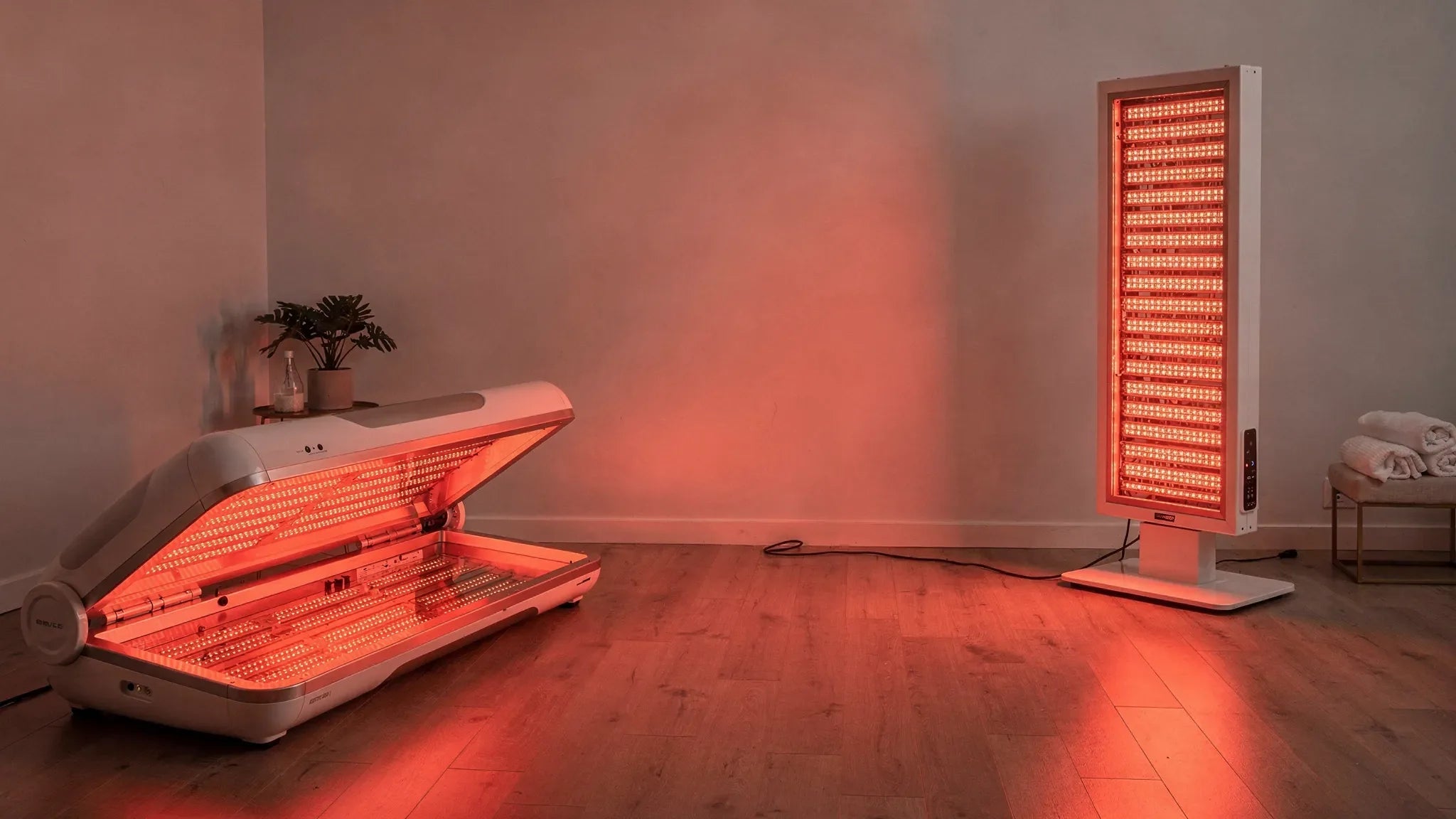
For full-body or large-area exposure, the HealthLight Ultimate Body Kit uses FDA-cleared LED pad arrays that deliver clinical power densities (15–30 mW/cm²) at direct skin contact, which is the right intensity range for the photobiomodulation effect. For face-focused exposure that doubles as a skin treatment, the TheraFace Mask FDA Cleared delivers controlled red and near-infrared wavelengths in a hands-free wearable. Both qualify as HSA/FSA eligible medical devices with a Letter of Medical Necessity from your physician.
What to Avoid
Do not use red light therapy after you are already in bed trying to sleep — the device's switch-on light, any glance at a smartphone to adjust the timer, or the residual illumination can disrupt sleep onset. Run the session, turn the device off, complete your bedtime routine in dim warm light, then go to bed.
Red Light Therapy vs Other Sleep Interventions: Comparison
| Intervention | Red Light Therapy | Melatonin Supplement | Prescription Sleep Aid |
|---|---|---|---|
| Mechanism | Circadian + mitochondrial | Direct hormone supplementation | GABA receptor / sedation |
| Onset of effect | 5–14 days of consistent use | 30–60 minutes | 15–30 minutes |
| Sleep architecture impact | Increases deep sleep, neutral on REM | Mostly neutral | Often suppresses REM |
| Next-day grogginess | None documented | Mild in some users | Common |
| Tolerance / dependence risk | None | Minimal | Significant |
| HSA/FSA eligible | Yes (with LMN) | No (OTC) | Yes (prescription) |
| Best for | Chronic mild-moderate insomnia, circadian disruption | Acute jet lag, shift work | Severe acute insomnia |
Frequently Asked Questions
Does red light therapy actually help you sleep better?
Yes, with modest but consistent evidence. A 2025 systematic review of 11 RCTs (n=1,247) in Sleep Medicine Reviews reported pre-sleep red light reduces Pittsburgh Sleep Quality Index scores by 1.8–3.2 points and improves sleep onset latency by approximately 14 minutes. The effect is real but smaller than prescription sleep aids — it works best as part of an integrated sleep hygiene routine.
When should I use red light therapy for sleep?
Use it 30–90 minutes before your target bedtime, for 10–20 minutes per session. This timing coincides with the natural melatonin synthesis window. Earlier exposure does not produce the same sleep effect because the circadian system is in a different phase.
Can I use red light therapy while I'm trying to fall asleep?
No. Complete the session 30–90 minutes before bed, turn the device off, and finish your bedtime routine in dim warm room light. Using an active light source after lights-out disrupts sleep onset even if the wavelength is in the red range, because the cognitive activity of adjusting a device pulls you out of pre-sleep mode.
Is red light therapy for sleep HSA/FSA eligible?
Yes. FDA-cleared red light therapy devices like the HealthLight Ultimate Body Kit and TheraFace Mask qualify as HSA/FSA eligible medical equipment when prescribed for a documented sleep disorder. Most HSA/FSA administrators require a Letter of Medical Necessity from your physician citing the sleep diagnosis (insomnia, circadian disorder, or perimenopausal sleep disruption).
Does red light therapy disrupt melatonin like blue light does?
No. Blue light at 460–480 nm suppresses melatonin by up to 85% through melanopsin-containing retinal ganglion cells. Red light at 620–700 nm lies outside that peak melanopsin sensitivity range and has essentially zero suppressive effect on melatonin. This is the core mechanism that makes red light a sleep-safe wavelength choice.
How long until I see sleep improvements?
Most clinical protocols show measurable subjective improvement at 5–14 days of consistent use and stronger effects at 4–6 weeks. This is not a one-night fix. The mitochondrial and circadian changes underlying the effect compound with repeated exposure, so consistency matters more than session intensity.
Learn More From Our Red Light Therapy Library
For a deeper dive into the device most clinicians and at-home users recommend for full-body sessions, see our HealthLight Ultimate Body Kit review. For a different clinical application of the same photobiomodulation mechanism, see red light therapy for diabetic neuropathy.
Ready to Try Red Light Therapy for Sleep?
If you've tried everything else for sleep and want a low-risk, well-tolerated, evidence-backed adjunct, the HealthLight Ultimate Body Kit delivers FDA-cleared LED pad therapy at clinical power densities designed for full-body pre-bed sessions. For a face-focused option that doubles as a skin treatment, the TheraFace Mask FDA Cleared is a hands-free wearable that fits cleanly into a bedtime routine. Both devices may be purchasable with your HSA or FSA account with a Letter of Medical Necessity from your physician — for a documented sleep disorder this is typically straightforward to obtain. Check with your plan administrator about HSA/FSA eligibility before purchase.
Questions about which device fits your sleep situation, the right pre-bed protocol, or HSA/FSA documentation? Call (612) 360-2490 — we'll talk through your specific routine and help you avoid the most common mistake: buying a device with the wrong wavelength mix for the sleep effect you want.
About the Author
Justin Webster, owner of Your Health Sanctuary, has spent his career helping build over 20 niche medical clinics across the USA and has written 2 books on the subject. Working alongside dozens of MDs, he saw firsthand what actually works for weight loss, recovery, and anti-aging, and what doesn't. He even published a weight loss book centered on Apple Cider Vinegar. When he realized it wasn't at the level it needed to be, he had the humility to pull it entirely and start over. That willingness to hold himself to a higher standard, even when it costs him, is what drives how Your Health Sanctuary operates. Life and business experience in the medical field led to everything this store is built on. Justin has personally lost 55 lbs. and made anti-aging his obsession. He didn't start this store to push products. He started it because he knew the tools clinicians trust, the ones that deliver real results, were out of reach for most people. Your Health Sanctuary exists to change that.