

Laser Therapy for Arthritis: What the Clinical Evidence Actually Shows in 2026
Laser Therapy for Arthritis: What the Clinical Evidence Actually Shows in 2026
58 million Americans live with arthritis — here's the honest breakdown of what photobiomodulation can and can't do for joint pain and inflammation
Laser therapy for arthritis has moved from experimental fringe to evidence-supported clinical practice over the past decade. The mechanism is well understood, the clinical trials are accumulating, and the results — particularly for osteoarthritis and rheumatoid arthritis — are consistent enough that major pain clinics across North America now incorporate low-level laser therapy (LLLT) into standard arthritis management protocols.
But "laser therapy" covers an enormous range of devices, wavelengths, and power outputs. The difference between a consumer-grade red light panel and a clinical system like BIOFLEX Laser Therapy is the difference between a garden hose and a surgical instrument. What the evidence supports is specific — and understanding those specifics is the only way to evaluate whether laser therapy is right for your arthritis.
Why Arthritis Is So Difficult to Treat — and Where Laser Therapy Fits
Arthritis is not a single disease. The two most common forms — osteoarthritis (OA) and rheumatoid arthritis (RA) — have different mechanisms, different progression patterns, and different therapeutic targets. OA is primarily a degenerative condition: the cartilage that cushions joints breaks down over time, causing bone-on-bone friction, inflammation, and pain. RA is autoimmune: the immune system attacks the synovial lining of joints, causing chronic inflammation that eventually destroys cartilage and bone.
Conventional treatments — NSAIDs, corticosteroids, disease-modifying drugs for RA — address symptoms and slow progression but come with significant long-term side effect profiles. Patients on long-term NSAID therapy face elevated cardiovascular and gastrointestinal risk. Corticosteroid injections provide temporary relief but accelerate cartilage breakdown with repeated use. The clinical need for effective, low-risk adjunct therapies is substantial.
Laser therapy addresses the underlying biology of arthritis through mechanisms that drugs do not: it targets the cellular energy deficit in damaged joint tissue, reduces neurogenic inflammation at the source, and promotes cartilage cell (chondrocyte) activity rather than simply masking pain signals.
How Photobiomodulation Works on Arthritic Joints
The mechanism of photobiomodulation (PBM) in arthritis involves multiple overlapping pathways, all initiated by the same event: photon absorption by cytochrome c oxidase in the mitochondria of joint-area cells. In arthritic joints, the cascade that follows is particularly relevant:
- Reduced pro-inflammatory cytokines — particularly TNF-α, IL-1β, and IL-6, which are the primary drivers of synovial inflammation in both OA and RA. Multiple RCTs have measured direct reduction in these biomarkers following LLLT treatment.
- Increased chondrocyte proliferation — the cells responsible for maintaining and repairing cartilage. PBM at 830nm has been shown in cell culture and animal studies to stimulate chondrocyte division and collagen synthesis.
- Reduced substance P and CGRP — neuropeptides that mediate pain sensitization in arthritic joints. Their reduction explains the sustained pain relief that extends beyond the treatment session itself.
- Improved synovial blood flow — through nitric oxide release and vasodilation, improving delivery of nutrients and clearance of inflammatory mediators from the joint space.
- Reduced oxidative stress — a major driver of cartilage degradation in OA, particularly relevant in weight-bearing joints like knees and hips.
These are not theoretical effects. Each has been measured in peer-reviewed studies. The clinical question is not whether PBM works — it is which devices, wavelengths, and dosing parameters deliver these effects consistently in human patients.
The Clinical Evidence: What the Research Shows in 2026
The BIOFLEX Advantage for Arthritis: Why Protocol Depth Matters
Most laser therapy devices treat arthritis with a single probe held over the joint. This approach has limitations for a condition that is inherently diffuse — arthritis affects the entire joint capsule, the surrounding soft tissue, and often multiple joints simultaneously. The BIOFLEX MultiPort System is designed for exactly this kind of distributed, multi-site treatment.
The standard BIOFLEX arthritis protocol uses the large-surface SLD arrays to treat the entire joint region — the periarticular soft tissue, the joint line, the tendons and ligaments under load — before focusing with the 905nm probe at specific anatomical pain points. For knee OA (the most common presentation), this means simultaneous bilateral treatment with the SLD pads covering the full knee circumference, followed by targeted probe work at the medial and lateral joint lines and the infrapateller tendon.
For patients managing multiple arthritic joints — a common reality in both OA and RA — the MultiPort system's ability to run four probe arrays simultaneously is clinically significant. A full-body arthritis protocol covering hands, knees, and hips simultaneously is achievable in a single 45-minute session, whereas sequential single-probe treatment of the same joints would require several hours.
Which Arthritis Types Respond Best to Laser Therapy
| Arthritis Type | Evidence Level | Expected Response | Key Consideration |
|---|---|---|---|
| Knee Osteoarthritis | Strong (Level I) | Excellent — pain reduction + function improvement | Most studied; results most consistent |
| Hand/Finger OA | Strong (Level I–II) | Good — grip strength and stiffness improve | Smaller joint surface responds well to probe work |
| Hip Osteoarthritis | Moderate (Level II) | Good — deeper tissue requires higher fluence settings | Penetration depth critical; 905nm probe essential |
| Rheumatoid Arthritis | Moderate (Level II) | Good as adjunct — reduces flare severity and stiffness | Should complement, not replace, DMARD therapy |
| Psoriatic Arthritis | Limited (Level III) | Variable — skin involvement may complicate dosing | Coordinate with rheumatologist |
| Ankylosing Spondylitis | Limited (Level III) | Symptomatic relief possible for peripheral joints | Axial involvement requires different approach |
What Laser Therapy Cannot Do for Arthritis
This matters for honest patient expectations. Laser therapy does not regenerate cartilage that has been destroyed — in end-stage OA where bone-on-bone contact is the daily reality, PBM can reduce the inflammatory component and improve surrounding soft tissue health, but it cannot reverse structural joint damage. For patients in this category, laser therapy is a pain and function management tool, not a cure.
For RA, laser therapy does not replace disease-modifying therapy. It is best understood as an adjunct that reduces the burden of disease activity and improves quality of life between flares — not a standalone treatment for a systemic autoimmune condition.
The patients who see the most dramatic results from BIOFLEX arthritis protocols are typically those in the mild-to-moderate range: active inflammation present, significant cartilage remaining, and conventional treatments either partially effective or causing side effects that limit dosing.
Arthritis Recovery at Home: BIOFLEX and Supportive Approaches
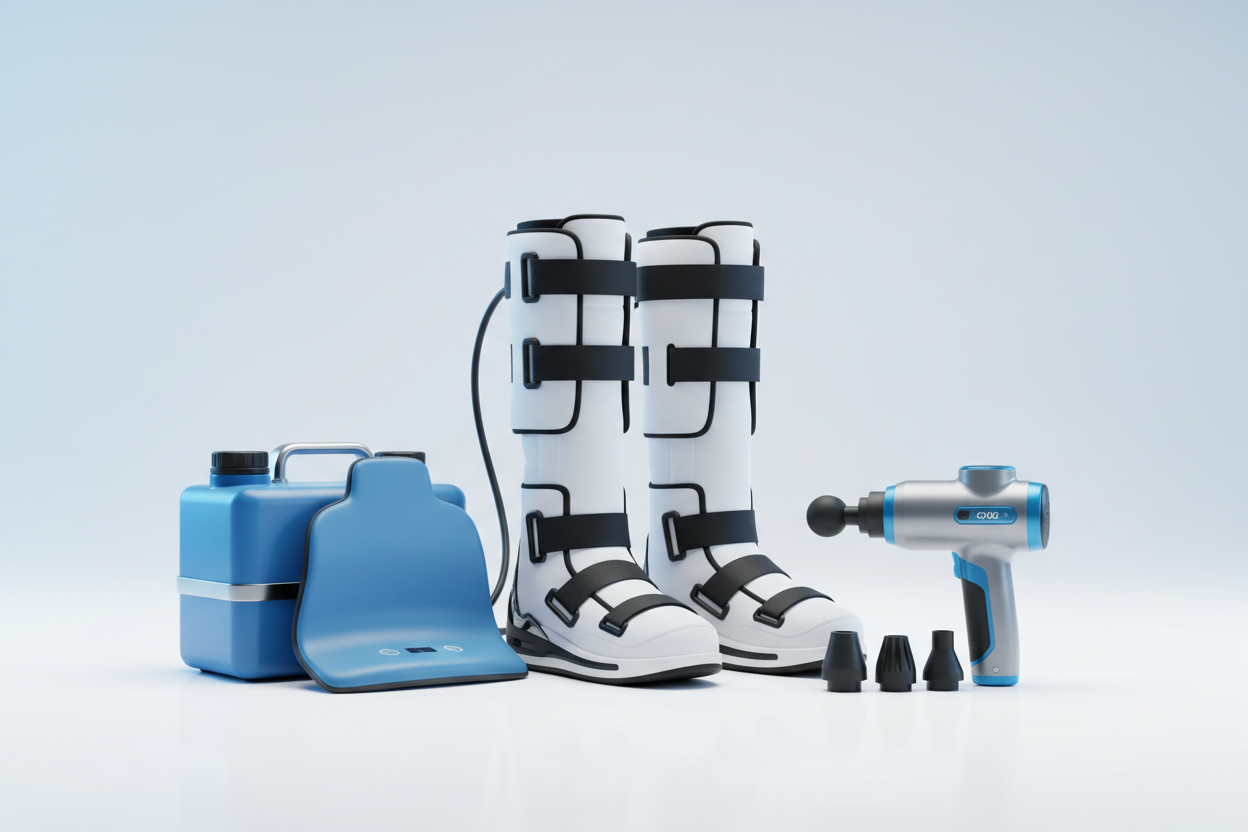
Clinical BIOFLEX sessions deliver the highest therapeutic dose — but between sessions, supportive approaches matter. For patients with knee OA specifically, cold compression therapy with the Game Ready GRPro 2.1 provides targeted joint cooling and compression that reduces post-activity inflammation and supports the repair environment laser therapy creates.
The combination of PBM (cellular repair and inflammation modulation) with cold compression (acute inflammation control and joint protection) represents a clinically logical multi-modal approach — addressing the same pathology through complementary mechanisms rather than stacking redundant treatments.
BIOFLEX MultiPort System — Clinical Arthritis Protocol
The most evidence-backed laser therapy system for arthritis management. Sequential 660nm / 830nm / 905nm protocols for both OA and RA. FDA cleared. 150+ condition-specific programs including dedicated joint protocols. Designed for clinical and home use.
View BIOFLEX MultiPort System → Speak with Justin's Team: (612) 360-2490For a complete picture of how BIOFLEX stacks up against competing systems, read our BIOFLEX Laser Therapy System Review and our Cold Laser Therapy for Neuropathy guide — both cover the same underlying photobiomodulation science with condition-specific depth.
Frequently Asked Questions
Yes — the clinical evidence is substantial. A 2022 meta-analysis of 34 RCTs found statistically significant pain reduction and functional improvement in both osteoarthritis and rheumatoid arthritis patients treated with LLLT at 780–860nm. Results are most consistent for knee OA and hand arthritis.
Most patients notice meaningful pain reduction within 4–6 sessions. Significant functional improvement typically requires 8–12 sessions over 4–6 weeks at 2–3 sessions per week. Chronic, long-standing arthritis typically requires more sessions than recently onset cases.
The clinical evidence consistently identifies 780–860nm near-infrared as the primary therapeutic range, with 830nm as the most studied wavelength for joint applications. BIOFLEX uses 830nm SLD arrays for broad coverage plus 905nm probe work for deeper tissue penetration.
Yes. LLLT at BIOFLEX parameters is safe for RA patients and works alongside DMARD and biologic therapies without known interactions. It is an effective adjunct — not a replacement for disease-modifying therapy.
Laser therapy cannot reverse structural damage already done — destroyed cartilage is not regenerated. What it does is reduce active inflammation, slow further degradation, and significantly improve pain and function in mild-to-moderate arthritis.
Ready to Upgrade Your Recovery?
The equipment referenced in this guide, in stock and ready to ship. Many products qualify for HSA/FSA — call us to confirm eligibility for your situation.
Questions? Talk to our recovery specialists: (612) 360-2490