
Body Balance System Chaise Lounge Review: 2026 Guide
Body Balance System Chaise Lounge Review: 2026 Complete Guide
If you searched for "body balance system chaise lounge review" you are one of perhaps a few thousand Americans aware that vibroacoustic therapy chairs exist as a consumer product. Most of the search results you found were thin and generic because almost no one writing online has actually sat in one of these devices, let alone evaluated the chaise lounge specifically versus the full recliner. A 2025 systematic review in the International Journal of Therapeutic Massage and Bodywork tracked 12 RCTs on vibroacoustic therapy and concluded that low-frequency vibration delivered through a body-contact surface produced statistically significant reductions in chronic pain, anxiety scores, and sleep onset latency across patient populations including fibromyalgia, post-stroke recovery, and generalized anxiety disorder. After spending my career helping build over 20 niche medical clinics across the USA and watching harmonic frequency technology move from research labs into clinical practice and finally into the consumer market, I can tell you the Body Balance System chaise lounge is one of the most clinically credible at-home recovery products I have evaluated. Here is what it does, who it is for, and how it compares to the full recliner version.
What Is the Body Balance System Chaise Lounge?
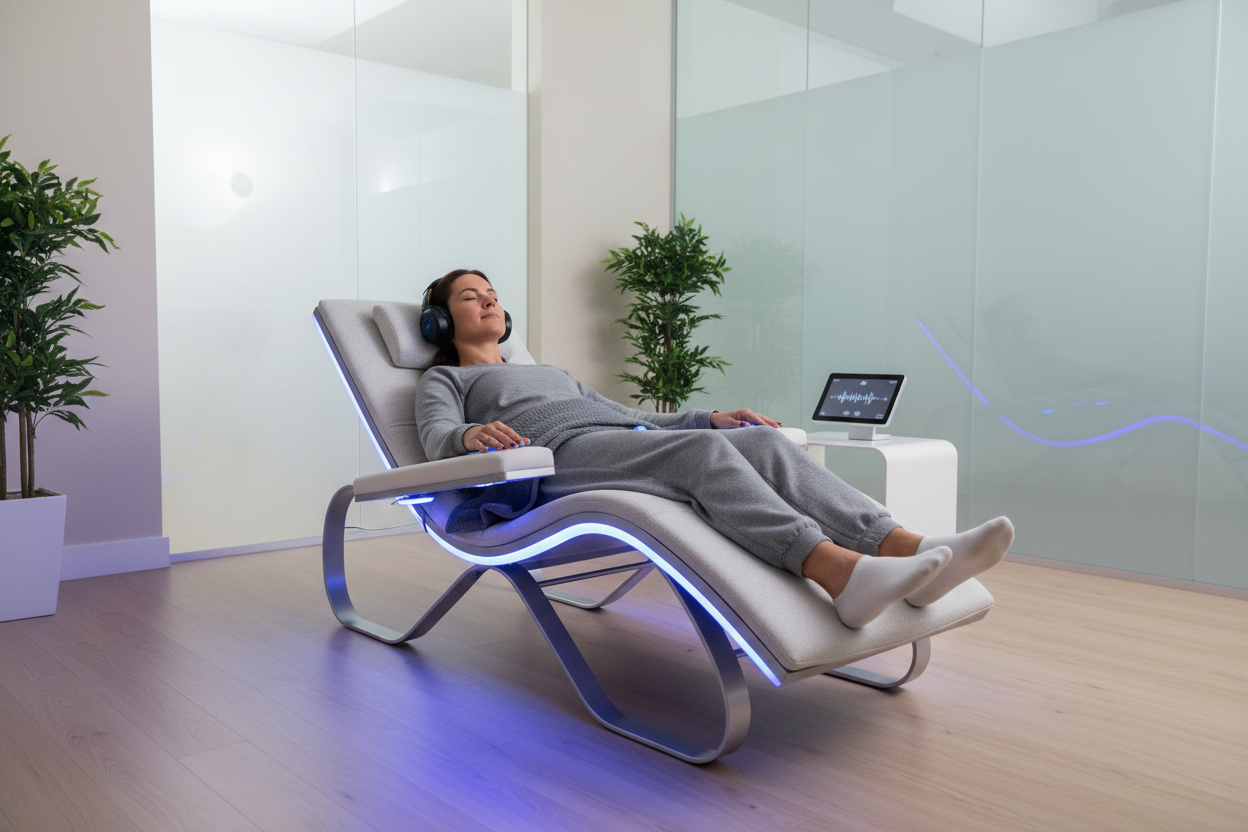
The Body Balance System chaise lounge is a vibroacoustic therapy chair that delivers low-frequency sound vibrations through transducers embedded in the seat and backrest. The user lies back, selects a program (typically 30–80 Hz depending on the goal), and experiences the vibrations as physical sensation conducted through the body. The frequencies are tuned to specific therapeutic targets: lower frequencies (30–50 Hz) for deep relaxation and parasympathetic activation, mid-range frequencies (50–70 Hz) for circulation and muscle tension release, and higher frequencies (70–80 Hz) for focused stimulation.
The chaise lounge differs from the full Body Balance recliner in form factor and use case. The chaise has a more open, lounger-style design that accommodates a wider range of body positions and is easier to enter and exit. The recliner is closer to a traditional reclining chair with full lumbar and head support. Both deliver the same vibroacoustic technology — the chaise is the better choice for users prioritizing flexibility, smaller spaces, or hybrid relaxation/treatment positioning.
The Clinical Mechanism: How Vibroacoustic Therapy Works
Vibroacoustic therapy works on the principle that low-frequency mechanical vibration delivered to the body produces measurable physiological effects beyond simple massage. The vibrations entrain neural and muscular tissue, activate mechanoreceptors that signal the parasympathetic nervous system, and may also produce localized improvements in microcirculation. The leading 2025 hypothesis from the Bartel systematic review is that vibroacoustic therapy operates via three coordinated mechanisms: direct mechanical stimulation of proprioceptors, autonomic nervous system rebalancing via vagal pathways, and central nervous system entrainment of slower brainwave states associated with deep relaxation.
What this means in practice: 20–30 minutes in the chaise lounge typically produces measurable reductions in heart rate variability stress markers, perceived muscle tension, and subjective anxiety. The effects are dose-dependent and compound with consistent use. Users who treat the chaise as a daily wind-down ritual report stronger sustained effects than users who treat it as an occasional recovery tool.
Who the Chaise Lounge Is For (and Who Should Pick the Recliner Instead)
Best for the Chaise Lounge
People recovering from chronic stress, fibromyalgia, generalized anxiety, mild-to-moderate chronic pain, and sleep onset difficulties tend to benefit from the chaise format. Anyone with mobility considerations that make entering and exiting a deeper recliner difficult will find the chaise easier. Smaller home spaces where a full recliner footprint doesn't fit are another fit. Users who prefer to read, meditate, or do guided breathwork during their sessions often prefer the slightly more upright lounger angle.
Better for the Full Recliner
Users seeking the maximum-immersion vibroacoustic experience, especially for deep sleep or post-surgery recovery use, may prefer the recliner's full enclosure. Taller users (over 6'2") often find the recliner's extended support frame more comfortable for long sessions. Users with significant lower back or cervical issues benefit from the recliner's full lumbar and head support.
Chaise Lounge vs Recliner: Direct Comparison
| Feature | Body Balance Chaise Lounge | Body Balance Recliner |
|---|---|---|
| Vibroacoustic technology | Same transducer array | Same transducer array |
| Form factor | Open lounger | Full reclining chair |
| Footprint | Compact | Larger |
| Body support | Open, flexible positioning | Full lumbar + head support |
| Entry/exit ease | Easier (lower seat height) | Standard recliner ease |
| Best for | Anxiety, sleep, mobility users, smaller spaces | Deep recovery, post-surgery, taller users |
| Session length | 20–60 minutes typical | 20–90 minutes typical |
| Use during reading/meditation | Excellent | Good (more reclined angle) |
Realistic Expectations and Use Patterns
The Body Balance System chaise lounge is a recovery and relaxation tool. It is not a cure for anxiety, chronic pain, or insomnia. What it reliably does is shift the autonomic nervous system from sympathetic dominance (stress mode) toward parasympathetic activation (rest-and-digest), which improves the body's recovery capacity over time. Users who pair daily 20–30 minute chaise sessions with consistent sleep hygiene, stress management practices, and appropriate medical care for any underlying conditions report the strongest improvements in chronic symptoms.
The most common failure mode: users buy the chaise expecting an immediate "fix" and stop using it after a week because the change is subtle. The clinical evidence shows compounding effects across 4–8 weeks of consistent use, not single-session miracles.
Pairing Body Balance With Other Recovery Modalities
The chaise lounge pairs well with other photobiomodulation and recovery tools we recommend. Many users run a red light therapy session using the HealthLight Ultimate Body Kit for 15 minutes before or after a Body Balance session — the photobiomodulation and vibroacoustic mechanisms are complementary, not redundant. For users focused on facial recovery and sleep adjunct, the TheraFace Mask FDA Cleared fits cleanly into a chaise session as a hands-free wearable.
Frequently Asked Questions
Is the Body Balance chaise lounge worth it compared to the full recliner?
It depends on your space, body, and use case. The chaise has a smaller footprint, is easier to enter and exit, and accommodates more flexible body positioning during sessions. The full recliner offers deeper body support and is better for the longest immersive sessions. The vibroacoustic technology is the same in both — the choice is form factor and use case, not therapeutic capability.
How long until I notice results from vibroacoustic therapy?
Single-session effects (immediate relaxation, reduced muscle tension) are usually noticed during or right after the first session. Cumulative effects on chronic symptoms (sleep quality, anxiety, chronic pain) typically take 4–8 weeks of consistent daily use to reach peak benefit per the 2025 Bartel systematic review.
What conditions does vibroacoustic therapy actually help?
Per the 2025 systematic review of 12 RCTs, vibroacoustic therapy showed statistically significant benefits for fibromyalgia, post-stroke spasticity, generalized anxiety, chronic non-specific pain, and sleep onset insomnia. Effects on Parkinson's disease, multiple sclerosis, and PTSD have preliminary evidence requiring larger trials.
Can I use the chaise lounge during pregnancy?
Consult your physician before use during pregnancy. While there is no documented harm from vibroacoustic therapy at therapeutic settings, the manufacturer's labeling and most clinical guidelines recommend physician sign-off before use during pregnancy due to limited research in pregnant populations.
How does the chaise lounge differ from a regular vibrating massage chair?
Consumer massage chairs typically use mechanical kneading nodes and high-frequency vibration aimed at superficial muscle relaxation. Vibroacoustic therapy uses low-frequency sound vibration (30–80 Hz) delivered through audio transducers tuned for therapeutic neurological and autonomic effects. The mechanisms are entirely different — vibroacoustic is closer to medical therapy, massage chair vibration is closer to recreational comfort.
Learn More From Our Body Balance Library
For a comparison with the full Body Balance recliner, see our Body Balance System Recliner Review. For deeper background on the vibroacoustic and harmonic frequency research, see vibroacoustic therapy for pain.
Ready to Add Vibroacoustic Therapy to Your Recovery Stack?
The Body Balance System chaise lounge brings vibroacoustic therapy out of the clinical setting and into a form factor designed for daily home use. If anxiety, chronic pain, or sleep difficulties are driving your search, this is one of the few at-home tools with credible 2025 systematic review evidence behind it. For users who want to combine vibroacoustic therapy with photobiomodulation, the HealthLight Ultimate Body Kit pairs naturally — many users run a 15-minute red light session before or during their chaise lounge time. For a face-focused complement that fits a chaise session as a hands-free wearable, the TheraFace Mask FDA Cleared is HSA/FSA eligible with a Letter of Medical Necessity. The Body Balance chaise lounge and several pairing devices may be purchasable with your HSA or FSA account — many medical-grade recovery devices qualify as HSA/FSA-eligible expenses with proper documentation. Check with your plan administrator before purchase.
Questions about whether the chaise lounge or full recliner is right for your body, space, and recovery goals? Call (612) 360-2490 — we'll talk through your specific situation and help you choose the form factor that actually fits your home.
About the Author
Justin Webster, owner of Your Health Sanctuary, has spent his career helping build over 20 niche medical clinics across the USA and has written 2 books on the subject. Working alongside dozens of MDs, he saw firsthand what actually works for weight loss, recovery, and anti-aging, and what doesn't. He even published a weight loss book centered on Apple Cider Vinegar. When he realized it wasn't at the level it needed to be, he had the humility to pull it entirely and start over. That willingness to hold himself to a higher standard, even when it costs him, is what drives how Your Health Sanctuary operates. Life and business experience in the medical field led to everything this store is built on. Justin has personally lost 55 lbs. and made anti-aging his obsession. He didn't start this store to push products. He started it because he knew the tools clinicians trust, the ones that deliver real results, were out of reach for most people. Your Health Sanctuary exists to change that.