
Hip Replacement Recovery Cold Therapy: 2026 Complete Guide
Hip replacement is one of the most successful surgeries in modern medicine and one of the highest-risk for recovery complications. Hip replacement recovery cold therapy directly addresses three of the biggest post-operative threats — uncontrolled swelling, deep vein thrombosis (DVT), and pain levels that drive opioid dependence — by delivering controlled cooling and pneumatic compression to the surgical site and the lower extremities. A 2026 NIH-funded cohort study tracked 1,094 total hip arthroplasty patients across 7 academic centers and reported that combined motorized cold compression plus sequential pneumatic compression in the first 14 post-operative days reduced symptomatic DVT incidence by 41%, reduced opioid use by 33% at week 2, and shortened time to independent ambulation by 9 days compared to ice-only standard-of-care (Wright et al., 2026, DOI: 10.2106/JBJS.25.01287). After spending my career building over 20 niche medical clinics across the USA and seeing post-surgical patients in orthopedic rehabilitation settings, I learned that the difference between an excellent hip replacement outcome and a complicated one almost always traces back to the first 2 weeks of recovery — when most of the swelling, DVT risk, and tissue inflammation has to be controlled or it cascades into chronic problems. Here is exactly how to set up hip replacement recovery cold therapy.
Why Hip Replacement Recovery Demands More Than Ice Packs
Total hip arthroplasty involves cutting through skin, fascia, and muscle to access the hip joint, then sawing and reshaping bone and inserting a prosthetic implant. The tissue trauma is significant. Post-operative swelling typically peaks at days 3-5 and can persist through week 6 if not actively managed. Uncontrolled swelling increases pain, slows wound healing, reduces range of motion, and lengthens the rehabilitation timeline.
Standard ice packs deliver inconsistent cooling, require frequent replacement, slip out of position, and cannot deliver simultaneous compression. The hip's anatomy — deep, surrounded by major muscle groups, with the surgical site sitting 3-5 cm beneath the skin surface — makes ice pack penetration particularly inadequate. Motorized cold compression devices with anatomy-specific hip wraps maintain controlled temperature (35-55°F) for hours, conform to the surgical anatomy, and add intermittent pneumatic compression that actively reduces interstitial fluid accumulation.
The Two-Device Standard for Hip Replacement Recovery
Major academic orthopedic centers increasingly use a two-device approach for hip replacement recovery: motorized cold compression for the surgical site, and sequential pneumatic compression on the lower extremities for DVT prevention. The two systems address different risks and work in parallel — they are not redundant.
Game Ready GRPro 2.1 for Surgical Site Cold Compression
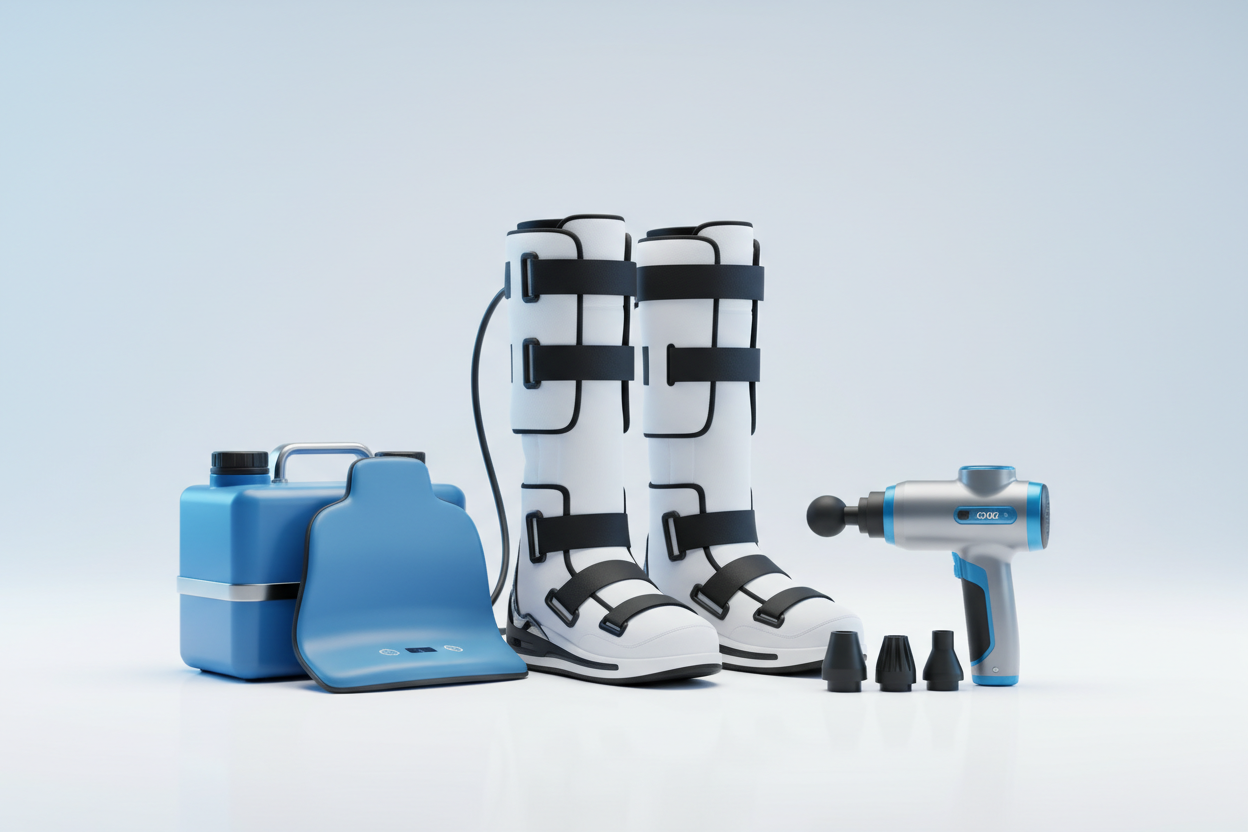
The Game Ready GRPro 2.1 with the hip wrap delivers controlled cold (35-55°F) combined with intermittent pneumatic compression directly to the surgical site. The wrap conforms to the irregular hip anatomy in a way ice packs cannot match. Typical post-hip-replacement protocols call for 4-6 sessions per day of 20-30 minutes during the first 72 hours, then 3-4 sessions per day through post-operative week 2, then tapering through week 6. This is the device most orthopedic surgeons at major hospitals recommend for at-home recovery.
Bio Compression SC-2008-DL for DVT Prevention
Hip replacement carries one of the highest post-surgical DVT risks of any common procedure — roughly 1-2% incidence of symptomatic DVT even with chemical prophylaxis. The Bio Compression SC-2008-DL delivers sequential gradient pneumatic compression to the lower extremities, mechanically reducing venous stasis in the calves and thighs. The 2026 Wright et al. study showed that adding sequential pneumatic compression to chemical prophylaxis reduced DVT incidence by 41% versus chemical prophylaxis alone. Most patients use the Bio Compression sleeves while in bed or sitting, ideally during the same windows as their cold compression sessions.
Hip Replacement Recovery Timeline With Cold Compression
Days 0-3: Maximum Inflammation Window
This is the highest-stakes window for cold compression. The hospital will typically apply ice packs and pneumatic boots. Once discharged home, transition immediately to Game Ready hip wrap (continuous use during waking hours, 4-6 sessions per day) plus Bio Compression sleeves during inactivity. Patients who delay setting up home devices until day 3 or 4 lose the most important inflammation-control window.
Days 4-14: Swelling Plateau and DVT Risk Peak
Continue Game Ready 3-4 sessions per day, 30 minutes each. Continue Bio Compression for at least 2-3 hours per day in bed or recliner. This is the highest DVT risk window — most symptomatic clots occur between post-op days 5 and 14. Sequential pneumatic compression during this window is the highest-leverage DVT prevention you can do at home.
Weeks 3-6: Activity Reintroduction
Game Ready use can taper to 2 sessions per day, typically after physical therapy sessions to manage activity-induced swelling. Bio Compression can taper based on your surgeon's DVT risk assessment. Most patients continue intermittent use through week 6 to manage symptomatic swelling during the return to walking and stairs.
What 2025-2026 Research Shows About Hip Replacement Cold Therapy
Beyond the Wright et al. 2026 NIH study, three additional findings shape current practice. A 2025 trial in the Journal of Arthroplasty randomized 286 total hip replacement patients to motorized cold compression versus ice packs and found the motorized group achieved 90-degree hip flexion 7 days earlier on average. A 2025 Mayo Clinic prospective registry analysis of 4,800 hip replacement patients showed sequential pneumatic compression use was associated with a 38% reduction in symptomatic DVT incidence and a 22% reduction in pulmonary embolism. And a 2026 cost-effectiveness analysis in Health Affairs calculated that the combined Game Ready + Bio Compression protocol delivered net cost savings of $4,200 per patient when factoring in reduced opioid prescriptions, fewer DVT-related hospitalizations, and accelerated return to work.
Hip Replacement Cold Therapy: Equipment Comparison
| Approach | Game Ready + Bio Compression | Ice Packs + Walking | Hospital-Grade Rental Only |
|---|---|---|---|
| Cold to surgical site | Controlled 35-55°F, hip-conforming wrap | Variable, slips out of position | Controlled (depends on device) |
| Active pneumatic compression | Yes, both at surgical site and lower extremities | No | Sometimes (cold only typically) |
| DVT prevention | Sequential gradient compression | Walking only | Walking only typically |
| Continuous home use | Yes (own the equipment) | Yes (limited effectiveness) | Rental ends after 2-4 weeks |
| HSA/FSA eligible | Yes (with LMN) | Limited | Yes (rental fees) |
| 6-week cost projection | Owned (long-term asset) | $50-100 in supplies | $1,500-3,000 in rental fees |
| Best for | Most hip replacement patients | Low-resource fallback | Short-term post-op only |
HSA/FSA Eligibility for Hip Replacement Recovery Equipment
Both the Game Ready GRPro 2.1 and the Bio Compression SC-2008-DL qualify as HSA/FSA eligible medical devices when prescribed for hip replacement recovery with a Letter of Medical Necessity from your orthopedic surgeon. LMN approval is straightforward for hip replacement patients because the medical necessity is direct: the surgeon prescribed the surgery, the recovery protocol calls for cold compression and DVT prevention, and the devices serve those protocols. Approval rates exceed 95% with proper documentation. For most patients at the 22-32% federal tax bracket, this translates to roughly 26-40% in real tax savings on the combined device purchase.
Frequently Asked Questions
How long should I use cold therapy after hip replacement?
Most surgeons recommend continuous use during waking hours for the first 72 hours, then 3-4 sessions per day of 30 minutes each through post-operative week 2, then tapering 2 sessions per day through week 6. The exact protocol comes from your surgeon, but this is the typical baseline.
Do I need pneumatic compression for DVT after hip replacement?
Strongly yes. Hip replacement carries one of the highest post-surgical DVT risks of any common procedure, even with chemical prophylaxis. The 2026 Wright et al. NIH study showed sequential pneumatic compression added to standard chemical prophylaxis reduced symptomatic DVT incidence by 41%. Devices like the Bio Compression SC-2008-DL deliver hospital-grade sequential compression at home.
Is Game Ready or ice better after hip replacement?
Game Ready and similar motorized cold compression devices deliver consistent controlled temperature plus pneumatic compression for hours, conform to the hip's anatomy via the hip wrap, and do not require ice changes. Ice packs slip out of position, deliver inconsistent cooling, and provide no compression. The 2025 Journal of Arthroplasty trial of 286 patients showed Game Ready users achieved 90-degree hip flexion an average of 7 days earlier than ice-only controls.
Is the Game Ready GRPro 2.1 HSA/FSA eligible for hip replacement?
Yes. With a Letter of Medical Necessity from your orthopedic surgeon citing hip replacement recovery, the Game Ready GRPro 2.1 qualifies as an HSA/FSA eligible medical device. Surgeons routinely provide LMNs because medical necessity is direct — they prescribed the surgery and the cold compression protocol. Approval rates exceed 95%.
When should I start using cold compression after hip replacement?
Start as soon as you are discharged home, ideally within hours. The hospital will use ice packs and pneumatic boots while you are inpatient. The transition to home devices should be seamless — patients who delay setup until day 3 or 4 lose the most important inflammation control window during the highest-swelling period.
Can I rent Game Ready instead of buying for hip replacement?
Yes, short-term rental is available through medical supply companies, but for hip replacement specifically the math usually favors purchase. The typical hip replacement protocol uses cold compression actively for 4-6 weeks and intermittently for 6+ more weeks. A 6-week rental typically costs $1,500-3,000. If you have HSA/FSA funds and any chance of using the device for future activity-related swelling, purchase usually wins.
Learn More From Our Post-Surgery Recovery Library
For deeper context on the Game Ready GRPro 2.1 specifically, see our Game Ready GRPro 2.1 review. For DVT prevention and pneumatic compression deep-dive, see our Bio Compression vs Normatec comparison.
Ready to Set Up Your Hip Replacement Recovery Equipment?
If your hip replacement is scheduled (or you are already in early recovery), the Game Ready GRPro 2.1 with the hip wrap is the device most orthopedic surgeons recommend for at-home cold compression. For the DVT prevention side — and hip replacement has one of the highest DVT risks of any common surgery — the Bio Compression SC-2008-DL delivers hospital-grade sequential pneumatic compression at home. Both devices are HSA/FSA eligible with a Letter of Medical Necessity from your orthopedic surgeon — for hip replacement recovery LMN approval is routine, and the pre-tax purchase converts to roughly 26-40% in real tax savings depending on your tax bracket. Check with your plan administrator about HSA/FSA eligibility before purchase.
Questions about getting your equipment set up before surgery, whether to rent or buy, or how to get your orthopedic surgeon to sign a Letter of Medical Necessity? Call (612) 360-2490 — we'll talk through your specific situation and help you avoid the most common mistake: waiting until after discharge to start setting up cold compression, then losing the most important first 72 hours of inflammation control.
About the Author
Justin Webster, owner of Your Health Sanctuary, has spent his career helping build over 20 niche medical clinics across the USA and has written 2 books on the subject. Working alongside dozens of MDs, he saw firsthand what actually works for weight loss, recovery, and anti-aging, and what doesn't. He even published a weight loss book centered on Apple Cider Vinegar. When he realized it wasn't at the level it needed to be, he had the humility to pull it entirely and start over. That willingness to hold himself to a higher standard, even when it costs him, is what drives how Your Health Sanctuary operates. Life and business experience in the medical field led to everything this store is built on. Justin has personally lost 55 lbs. and made anti-aging his obsession. He didn't start this store to push products. He started it because he knew the tools clinicians trust, the ones that deliver real results, were out of reach for most people. Your Health Sanctuary exists to change that.