
ACL Surgery Recovery Equipment: The Complete Guide to Healing Faster
ACL Surgery Recovery Equipment: The Complete Guide to Healing Faster
The cold compression, sequential compression, and percussive therapy tools professional sports medicine actually uses after ACL reconstruction — and the clinical evidence behind each one.
Choosing the right ACL surgery recovery equipment is one of the most consequential decisions you'll make after anterior cruciate ligament reconstruction — and most patients make it without knowing what the clinical evidence actually says. The anterior cruciate ligament provides rotational stability to the knee, and after reconstruction surgery, the standard rehabilitation timeline runs 9 to 12 months before return to full sport. A 2020 study in the Journal of Orthopaedic & Sports Physical Therapy found that athletes who returned before 9 months had a rate of new ACL injury seven times higher than those who waited [11]. The equipment you use in those months directly influences how fast you heal and how completely you recover.
I've spent two decades helping build medical clinics across the country and working alongside orthopedic surgeons and physical therapists. The pattern is consistent: the patients who recover fastest are the ones who control three things aggressively from day one — swelling, pain, and muscle atrophy. The right recovery equipment is what makes that control possible at home, not just during your twice-weekly PT appointments.
This guide covers exactly what you need: cold compression therapy, sequential compression boots, and percussive therapy devices — what each one does, what the peer-reviewed research shows, how they map to the four phases of ACL rehab, and how to build a complete home setup that matches a professional sports medicine facility. Whether you're pre-op planning or already in week three, you'll know precisely what to prioritize and why.
ACL Recovery Equipment Comparison: What Actually Matters
Before we get into each tool, here's how the common options compare across the factors that matter most after surgery. Notice that the gap between a bag of ice and a professional cold compression system isn't marketing — it's measurable temperature control and active compression.
| Capability | Ice Bag / RICE | Basic Consumer Device | Professional Grade (YHS) |
|---|---|---|---|
| Temperature control | ✗ Drops fast, uneven | ~ Non-circulating | ✓ Circulated, consistent (Game Ready) |
| Active compression | ✗ None | ✗ Passive only | ✓ Intermittent pneumatic (ATX) |
| Session duration | ✗ 20–30 min max | ~ 45–60 min static | ✓ Extended with refills |
| Full-leg edema clearance | ✗ None | ~ Single zone | ✓ 7-zone sequential (Normatec 3) |
| Muscle/quad recovery support | ✗ None | ~ Fixed-head device | ✓ Adjustable percussion (Theragun G6) |
| HSA/FSA eligible | ✗ N/A | ~ Varies | ✓ Yes (Game Ready, prescribed use) |
| Used in pro training rooms | ✗ No | ✗ No | ✓ Yes — 20+ years |
The Four Phases of ACL Recovery and What Each Demands
ACL recovery follows a phased rehabilitation model. Each phase has distinct physical demands, and your equipment needs shift as you progress through them.
The surgical site is traumatized and inflamed. Goals: swelling reduction, pain management, graft protection. Cold compression therapy is the single most valuable tool. Cryotherapy after ACL reconstruction produces statistically significant postoperative pain reduction, confirmed in a meta-analysis of seven randomized controlled trials [2].
Swelling declines and you work on regaining full extension and beginning flexion. Sequential compression supports lymphatic drainage to clear residual edema. Gentle percussive therapy on surrounding musculature helps prevent the disuse atrophy that begins within days of immobilization [9].
Graft revascularization is underway. Closed-chain strengthening and aggressive quad recruitment dominate. Percussive therapy between sessions reduces delayed onset muscle soreness and muscle inhibition [12][13]. Cold compression after loading manages reactive swelling.
Running, agility, plyometrics. The full recovery stack supports high training loads. Critically, the evidence says do not rush this phase: returning before 9 months multiplies re-injury risk sevenfold [11].
A 2014 study in the Journal of Knee Surgery found that ACL reconstruction patients using combined cryotherapy and compression had dramatically better narcotic discontinuation — 83% were off narcotics by six weeks, compared with 28% of patients using ice alone [1]. Combined cold and compression isn't a comfort upgrade; it changes the pain-medication trajectory of your recovery.
Cold Compression Therapy — The #1 Priority After ACL Surgery
If there is one piece of ACL surgery recovery equipment that orthopedic surgeons and sports medicine physicians agree on, it is cold compression therapy. The combination of cold and controllable compression does something a bag of ice cannot: it delivers consistent, adjustable, cyclical compression that actively pumps edema out of the surgical site while holding temperature steady for extended periods.
Why Ice Packs Fall Short
A bag of ice loses its temperature within 20–30 minutes, requires constant repositioning, and delivers no active compression. There's also a safety concern: sustained contact with a too-cold surface risks frostbite, especially when nerve sensation near a fresh incision is reduced. The clinical literature shows continuous controlled cryotherapy maintains target tissue temperature far more consistently than ice or gel packs — and a 2008 study found continuous temperature-controlled cryotherapy produced better nighttime pain control after knee arthroscopy than simple icing [5]. The mechanism matters too: cold-induced vasoconstriction can persist long after cooling ends, which is why precise, sustained temperature delivery outperforms intermittent ice [7].
Game Ready GRPro 2.1 — Professional Cold Compression at Home
The Game Ready GRPro 2.1 is the industry standard for post-surgical cold compression and has been used in NFL, NBA, and Olympic training rooms for over two decades. It's the same system your hospital or PT clinic likely uses — now available for home use so you get that level of care around the clock, not just during appointments.
The GRPro 2.1 uses patented ATX (Active Temperature Exchange) technology that continuously circulates ice water through anatomically contoured wraps while applying intermittent pneumatic compression. That compression creates a pumping action that actively drives fluid away from the surgical site rather than just numbing it. A 2023 study found dynamic intermittent compression cryotherapy produced faster pain recovery than static compression cryotherapy after ACL reconstruction [15] — which is precisely the mechanism the GRPro 2.1 delivers.
"After ACL reconstruction, I recommend the Game Ready system to every patient who can use it at home. We see measurably less swelling in the first two weeks and patients consistently report lower pain scores than patients relying on ice bags. That faster swelling resolution lets us start quad activation exercises earlier, which is critical for preventing muscle atrophy." — Sports Physical Therapist, Division I University Athletic Program
Compression Boots — Managing Swelling Beyond the Knee
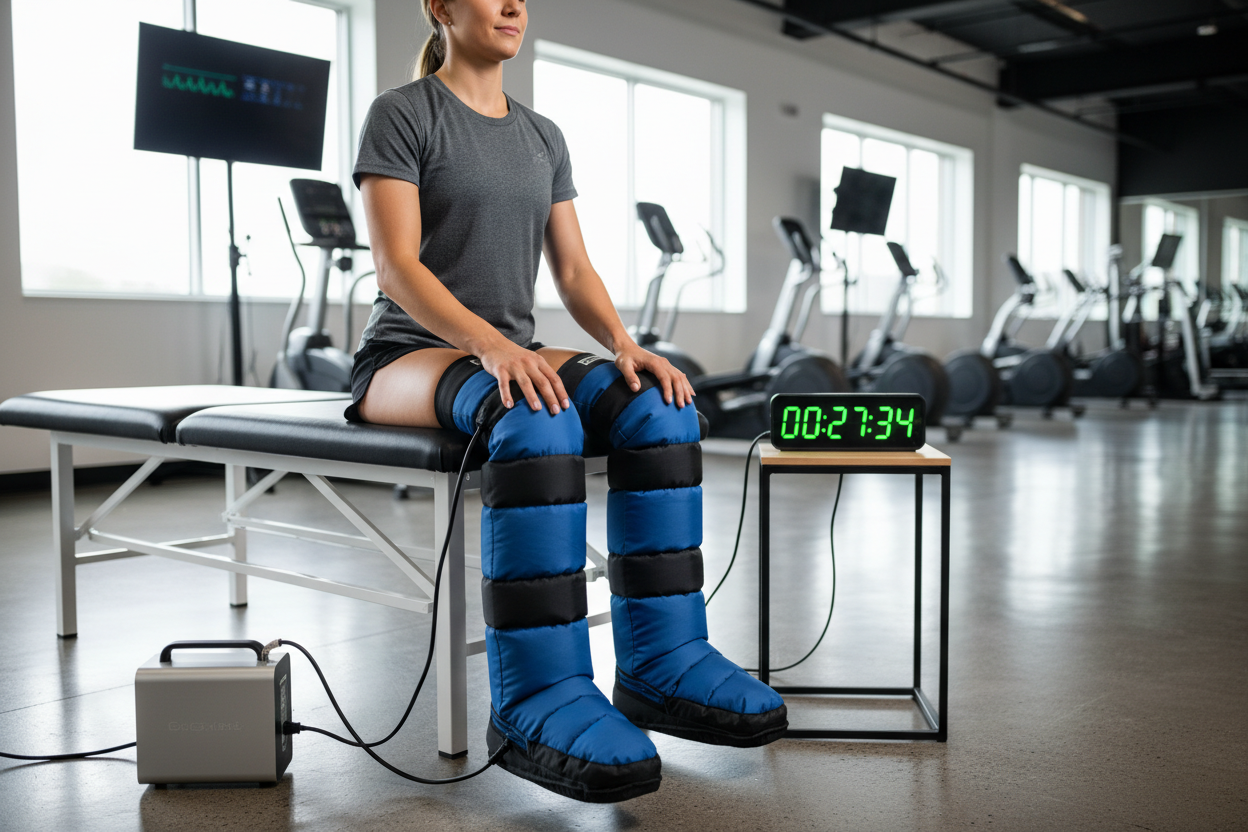
While cold compression addresses the knee joint directly, ACL patients also benefit from full-leg sequential compression. After knee surgery, the entire lower extremity experiences disrupted circulation and lymphatic flow — fluid pools in the calf, ankle, and thigh, not just the knee. Sequential compression boots address this systemic lower-leg edema in ways a knee wrap alone cannot.
How Sequential Compression Supports ACL Recovery
Sequential pneumatic compression devices inflate chambers in sequence from ankle to thigh, mimicking the natural muscular pumping action that drives venous blood and lymphatic fluid back toward the heart. During early recovery when weight-bearing is limited and calf activation is reduced, this mechanical pumping becomes important: it reduces DVT risk, clears metabolic waste from post-surgery inflammation, and reduces whole-leg swelling.
The Normatec 3 Full Body system delivers sequential compression using patented Pulse technology with overlapping zones and biomimicry algorithms that create a massage-like pattern closely matching physiological venous flow. Many ACL patients use it nightly during phases 1 and 2, then continue using it as a training recovery tool through the full rehab timeline.
For maximum effect, use cold compression on the knee first (immediately post-PT or post-exercise), then follow with a 20–30 minute compression boot session for the full leg. This addresses the localized surgical site first, then clears systemic lower-limb swelling — the exact protocol used in many professional sports training rooms.
Percussive Therapy — Preventing Quad Atrophy and Managing Muscle Tightness
Quadriceps atrophy is one of the most significant and persistent challenges in ACL recovery. A 2019 systematic review confirmed that quadriceps muscle size declines following ACL injury and reconstruction, and that this atrophy contributes to long-term quadriceps weakness if not addressed [9]. Within just 48–72 hours of post-surgical immobilization, measurable quad muscle mass begins to decline — partly from pain-induced inhibition (the nervous system reflexively reduces quad activation to protect the knee) and partly from disuse.
Where a Massage Gun Fits In
A percussive therapy device cannot replace your physical therapist's quad-setting exercises, but it plays an important complementary role. Applied to the quadriceps, hamstrings, IT band, and calves before PT, it reduces muscle inhibition and improves tissue pliability — making exercises more effective. Applied afterward, it reduces delayed onset muscle soreness. A 2024 randomized controlled trial in the Journal of Athletic Training (n=65) found that a five-minute massage gun application produced measurable perceptual recovery benefits after strenuous lower-body exercise [12], and a 2025 RCT confirmed percussion therapy accelerated DOMS recovery across pain, range of motion, and jump performance measures [13].
Theragun Pro Plus G6 — Precision Recovery for Post-Surgical Rehab
The Theragun Pro Plus G6 is the most advanced percussive therapy device available for home use. Its QuietForce technology runs quietly enough for evening use while delivering adjustable force at the surrounding musculature. For ACL recovery, the adjustable arm angles let you reach the posterior thigh and lateral knee without contorting in a way that stresses the joint. A 2023 systematic review found massage guns effectively improve flexibility across the hamstrings, calves, and posterior chain [14] — the exact muscle groups that tighten during ACL rehab.
Important safety note: Do not apply percussive therapy directly over the surgical site, incision, swollen tissue, or the knee joint itself in the early post-operative weeks. Work on the surrounding musculature — quads, hamstrings, glutes, calves — and always follow your physical therapist's guidance on when direct knee work is appropriate.
Quad Atrophy: The Recovery Battle Most Patients Underestimate
If there's one outcome that separates a complete ACL recovery from a compromised one, it's quadriceps strength symmetry. Persistent quad weakness is associated with worse functional outcomes and higher re-injury risk. The good news is that early, aggressive attention to the quad pays off, and the research points to several effective strategies.
Beyond your PT's prescribed exercises, the literature increasingly supports low-load blood flow restriction (BFR) training in early rehab. A 2024 meta-analysis found that low-load BFR training within six weeks post-ACL reconstruction improved quadriceps muscle size compared with conventional rehab [10]. Percussive therapy supports this work indirectly by reducing the muscle inhibition and soreness that otherwise limit how hard you can train the quad. The timing of surgery itself matters too — research suggests the optimal window for reconstruction with respect to minimizing quad atrophy lies within 21 to 100 days from injury.
Return-to-Sport Timing: Why Patience Is a Recovery Tool
The most important "equipment" in your ACL recovery may be a calendar. The single most robust finding in modern ACL rehabilitation research is that returning to sport too early dramatically increases the risk of a second ACL injury. The 2020 JOSPT study found that young athletes who returned before nine months had a rate of new injury seven times higher than those who delayed [11]. A 2023 meta-analysis reinforced this, confirming that delaying return to sport to at least nine months — and achieving symmetrical quadriceps strength — reduces second-injury risk [14].
Your recovery equipment supports patience by making each phase more productive: better swelling control means earlier quad activation, better muscle recovery means more effective strength sessions, and better pain management means you actually complete your rehab program. The tools don't replace time — they make the time count.
HSA/FSA Eligibility for ACL Recovery Equipment
Here's a detail that can meaningfully change your out-of-pocket cost: the Game Ready GRPro 2.1, as a post-surgical medical device used for a specific medical condition, is typically eligible as a qualified medical expense under Health Savings Accounts (HSA) and Flexible Spending Accounts (FSA) when prescribed for your ACL recovery.
For a system priced around $3,037, using pre-tax HSA or FSA dollars can effectively reduce the cost by roughly 22% to 37% depending on your tax bracket. For a patient who's just paid for ACL reconstruction surgery, that's a substantial difference — and it's worth confirming with your HSA/FSA plan administrator before purchase. A letter of medical necessity from your orthopedic surgeon (easy to obtain after a documented surgery) strengthens the eligibility case considerably.
Your Health Sanctuary is rolling out integrated HSA/FSA eligibility verification via Truemed at checkout. Call us at (612) 360-2490 for current status on which products qualify and how the verification process works.
Building Your Complete ACL Recovery Stack by Phase
You don't need everything at once. Here's a practical phased approach that prioritizes the highest-impact tools for each stage.
Days 0–14 (Acute Phase) — Highest Priority
Swelling and pain control is the urgent need. The single most impactful investment is the Game Ready GRPro 2.1 with the knee wrap. The evidence on cryo+compression in this window is strongest [1][2][15]. If budget is a concern, start here.
Weeks 2–8 (Subacute Rehab) — Second Priority
Add Normatec compression boots for full-leg recovery and lymphatic drainage. If you're doing PT three times a week with significant soreness between sessions, add the Theragun Pro Plus G6 for the surrounding musculature. Use it the evening after PT to reduce soreness going into the next day's exercises.
Months 3–9 (Functional Return) — Ongoing Use
The full stack is in active use: cold compression for reactive post-exercise swelling, compression boots after training, percussive therapy pre- and post-workout. These tools serve you well beyond ACL recovery — most athletes use professional-grade equipment for years across multiple training cycles.
Acquire your cold compression system before surgery if you can. The first 48–72 hours post-op are when cold compression therapy is most critical — and scrambling to order equipment during that window means missing the most important treatment period of your entire recovery.
Common Misconceptions About ACL Recovery Equipment
Misconception #1: "Ice and elevation are enough."
Ice alone loses temperature within half an hour and provides no compression. The clinical evidence shows combined, controlled cold and compression measurably outperforms ice — including an 83% versus 28% difference in narcotic discontinuation by six weeks [1]. The difference isn't comfort; it's the trajectory of your recovery.
Misconception #2: "Recovery boots are just for elite athletes."
Sequential compression addresses post-surgical lower-leg edema and DVT risk that every ACL patient faces, regardless of athletic level. The disrupted circulation after knee surgery is universal — the boots help the body do what limited weight-bearing prevents.
Misconception #3: "I should use my massage gun on the knee to break up scar tissue."
Never apply percussion directly over the surgical site, incision, or joint in early recovery. Percussive therapy belongs on the surrounding muscles. Direct knee work, if ever appropriate, is determined by your physical therapist.
Misconception #4: "If I feel good, I can return to sport early."
Feeling recovered and being structurally recovered are different. The graft revascularization and quad strength symmetry that protect against re-injury take time the literature consistently puts at nine-plus months [11]. Returning early multiplies re-injury risk sevenfold.
Get Professional-Grade Recovery Equipment
Your ACL recovery deserves the same tools used by professional athletes and sports medicine clinics. Many qualify for HSA/FSA — call us to confirm eligibility for your situation.
Questions? Talk to our recovery specialists: (612) 360-2490
Frequently Asked Questions — ACL Surgery Recovery Equipment
How long should I use cold compression therapy after ACL surgery?
Most orthopedic surgeons recommend cold compression for at least the first 2–4 weeks post-surgery, typically in 20–30 minute sessions every 2–3 hours while awake. Many patients continue using it after intense PT or strength sessions throughout the full 9–12 month recovery to manage reactive swelling. There's no fixed endpoint — use it whenever you experience swelling or post-exercise soreness. The strongest evidence for benefit is in the acute phase, where cryotherapy significantly reduces postoperative pain [2].
Is the Game Ready better than a standard cold therapy machine for ACL recovery?
The Game Ready GRPro 2.1 adds intermittent pneumatic compression to cold therapy, which standard cold-only machines don't provide. The active compression pumps edema out of the joint in addition to cooling it — and a 2023 study found dynamic intermittent compression cryotherapy produced faster pain recovery than static compression cryotherapy after ACL reconstruction [15]. This dual mechanism is why Game Ready is the preferred system in most professional sports training rooms.
Can I use a massage gun on my knee after ACL surgery?
Not directly over the surgical site, incision, swollen tissue, or joint in the early weeks. Percussive therapy is safe and beneficial on the surrounding musculature — quadriceps, hamstrings, IT band, glutes, and calves. Many PTs introduce massage gun use on surrounding muscles as early as week 2–3 post-op. Recent RCTs confirm percussion therapy benefits for muscle recovery and soreness [12][13]. Always follow your physical therapist's specific guidance on timing and technique.
Are compression boots beneficial for ACL recovery, or just for athletes?
They're extremely beneficial for ACL recovery and not exclusively athletic tools. After surgery the entire lower extremity has disrupted lymphatic and venous circulation due to trauma, reduced weight-bearing, and limited calf activation. Sequential compression boots replace the pumping action of normal walking to clear lower-leg edema and reduce DVT risk. Physical therapists frequently recommend sequential compression as part of post-ACL protocols.
Is ACL recovery equipment HSA or FSA eligible?
The Game Ready GRPro 2.1, as a post-surgical medical device prescribed for a specific condition, is typically HSA/FSA eligible. For a system around $3,037, pre-tax dollars can reduce the effective cost by roughly 22–37% depending on your tax bracket. A letter of medical necessity from your surgeon strengthens the claim. Confirm with your plan administrator before purchase, and call Your Health Sanctuary at (612) 360-2490 for current Truemed integration status.
When should I buy ACL recovery equipment — before or after surgery?
Whenever possible, acquire your cold compression system before surgery. The first 48–72 hours post-reconstruction are the most critical window for swelling management, and having equipment ready when you get home maximizes that window. For elective ACL reconstruction, purchase and familiarize yourself with your cold compression system, compression boots, and percussive device at least a week before your surgery date.
When can I safely return to sport after ACL reconstruction?
The research strongly supports waiting at least 9 months and achieving symmetrical quadriceps strength before returning to cutting and pivoting sports. A 2020 JOSPT study found that returning before 9 months produced a sevenfold higher rate of new ACL injury [11]. Return-to-sport readiness should be determined by objective strength and functional testing with your surgeon and physical therapist — not by how good your knee feels.
What's the single most important piece of ACL recovery equipment on a budget?
Cold compression therapy has the most direct evidence for improving acute-phase outcomes [1][2], so the Game Ready GRPro 2.1 is the highest-priority purchase for the first 2–4 weeks. Compression boots and a massage gun are valuable additions as you move into subacute and functional phases, but cold compression comes first. If upfront cost is a barrier, ask about rental programs for cold therapy machines.
Citations and References
- Murgier J, Cassard X. The efficacy of combined cryotherapy and compression compared with cryotherapy alone following anterior cruciate ligament reconstruction. J Knee Surg. 2014;27(3):257-262. PMID: 22928433
- Raynor MC, Pietrobon R, Guller U, Higgins LD. Cryotherapy after ACL reconstruction: a meta-analysis. J Knee Surg. 2005;18(2):123-129. PMID: 15915833
- Martin SS, Spindler KP, et al. Effectiveness and safety of cryotherapy after arthroscopic ACL reconstruction (systematic review). PMID: 24713365
- Su EP, et al. Continuous cryotherapy vs. traditional cryotherapy after total knee arthroplasty: a systematic review and meta-analysis of RCTs. Front Surg. 2023. PMID: 36713652
- Barber FA. Comparison of a continuous temperature-controlled cryotherapy device to a simple icing regimen following outpatient knee arthroscopy. Arthroscopy. 2008;24(3):334-339. PMID: 18300666
- Khoshnevis S, Craik NK, Diller KR. Cold-induced vasoconstriction may persist long after cooling ends. J Orthop Sports Phys Ther. 2015;45(3):200-208. PMID: 24562697
- Khoshnevis S, et al. Sustained cutaneous vasoconstriction during and following cryotherapy treatment. Microvasc Res. 2016. PMID: 27089823
- Lepley AS, Grooms DR, Burland JP, et al. Quadriceps muscle size following ACL injury and reconstruction: a systematic review. J Sport Rehabil. 2019. PMID: 31608490
- Lin Q, Zhang Y, Qin J, Wu F. Effects of low-load blood flow restriction training on muscle volume after ACL reconstruction: a systematic review and meta-analysis. Orthop J Sports Med. 2024. PMC11645764
- Konrad A, Glashüttner C, Reiner MM, et al. Under the gun: percussive massage therapy and physical and perceptual recovery in active adults. J Athl Train. 2024;59(3):310-316. PMID: 37248364
- Beischer S, Gustavsson L, Senorski EH, et al. Young athletes who return to sport before 9 months after ACL reconstruction have a rate of new injury 7 times that of those who delay. J Orthop Sports Phys Ther. 2020;50(2):83-90. PMID: 32005095
- Chen Y, et al. The effect of percussion massage therapy on the recovery of delayed onset muscle soreness in physically active young men: a randomized controlled trial. Front Public Health. 2025. PMID: 40206177
- Ferreira RM, et al. The effects of massage guns on performance and recovery: a systematic review. Healthcare (Basel). 2023. PMC10532323
- Dynamic intermittent compression cryotherapy results in faster pain recovery than static compression cryotherapy following ACL reconstruction. Knee Surg Sports Traumatol Arthrosc. 2023. PMC10366045
- Better safe than sorry? A systematic review with meta-analysis on time to return to sport after ACL reconstruction as a risk factor for second ACL injury. J Orthop Sports Phys Ther. 2023. JOSPT 2023
Related Reading — Surgery Recovery Equipment
- Rotator Cuff Surgery Recovery Equipment: The Complete 2026 Guide
- Game Ready GRPro 2.1 Review: Cold Compression for ACL & Rotator Cuff Recovery
- Compression Boots for Post Surgery Recovery: Complete 2026 Guide
- Cold Therapy Recovery Equipment: The Complete 2026 Guide
- Recovery Equipment for Post Surgery: The Complete 2026 Guide